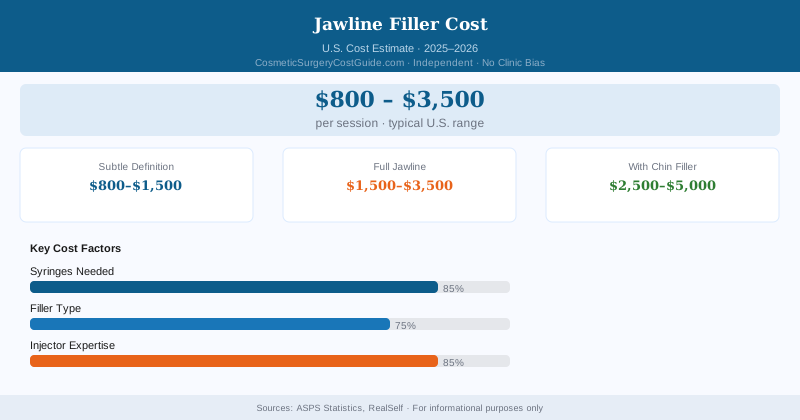
Let’s run the numbers first, because they tell an important story about when jawline filler makes sense and when you should be talking to a surgeon instead.
Three syringes of jawline filler at $900 per syringe: $2,700. That lasts 12–18 months. Do that twice in three years: $5,400. Do it consistently over five years: $9,000. Meanwhile, a one-time chin implant with some jaw contouring runs $5,000–$8,000 and is permanent. A lower facelift costs $14,000–$22,000 and lasts 8–12 years for significant aging correction.
The math doesn’t mean filler is wrong — for the right patient and the right goal, it’s excellent. But knowing the cumulative cost helps you figure out which category you’re actually in. According to ASPS 2024 data, hyaluronic acid filler procedures are among the most performed non-surgical treatments in the US, with the lower face seeing some of the fastest growth in recent years.
Jawline Filler Cost
| Goal | Syringes | Cost Range | Duration |
|---|---|---|---|
| Subtle definition/enhancement | 1–2 | $750–$2,000 | 12–18 months |
| Moderate contouring | 2–3 | $1,400–$3,000 | 12–18 months |
| Significant jowl correction | 3–5 | $2,100–$5,000 | 12–18 months |
| Jawline + chin combo | 2–4 | $1,500–$4,000 | 12–18 months |
| Jawline + chin + cheek (full lower face) | 4–7 | $3,000–$7,500 | 12–18 months |
What Products Work Best for the Jawline
The jawline needs stiffer, more structural fillers than soft areas like lips or under-eyes. The jawline has to hold its shape against gravity and movement. Most experienced injectors reach for:
Radiesse: Calcium hydroxylapatite — excellent for structural definition along the mandibular border. Provides immediate volume plus collagen stimulation. Lasts 18–24 months. One catch: it can’t be dissolved if something goes wrong.
Juvederm Voluma: High G’ (stiffness) makes it a good structural choice. Dissolvable with hyaluronidase if needed.
Restylane Lyft or Refyne: Both have structural integrity appropriate for the jawline. Good options when the patient wants the reversibility of a dissolvable product.
Sculptra: For diffuse lower face laxity, a course of Sculptra (2–3 sessions) can gradually improve skin quality and subtle structure throughout the lower face. Results are less targeted than direct filler placement but often look more natural in patients with broader laxity concerns.
Jawline filler can meaningfully improve early jowling — the soft tissue descent that creates a visible break in the jawline contour. By placing filler in the prejowl area and along the mandibular body, a skilled injector can recreate a sharper, more continuous jawline.
What filler can’t do: significantly lift heavy jowls, address substantial skin laxity, or produce the results a facelift or neck lift would for moderate-to-significant aging. Filler for jowl correction works best in patients in their 30s and 40s with early changes. For patients in their 50s+ with meaningful jowling, surgical consultation is worth having alongside injectable options.
Younger Patients: Jawline Definition vs. Restoration
Not everyone seeking jawline filler is correcting aging. Many patients in their 20s and 30s want a sharper, more sculpted appearance they never had — not restoration of something lost.
That’s a legitimate aesthetic goal, but it needs honest discussion with your injector. Filler adds modest definition. It can sharpen a soft mandibular angle somewhat and create more visible lower-face structure — but it can’t turn a naturally soft, rounded jaw into an angular one. Realistic expectations matter here.
Jawline Filler vs. Surgical Options
| Approach | Cost | Duration | Result Magnitude |
|---|---|---|---|
| 3 syringes filler/year | $2,100–$3,000/yr | 12–18 months | Moderate |
| Chin implant + jaw definition | $5,000–$8,000 once | Permanent | Significant |
| Lower facelift + neck lift | $14,000–$22,000 once | 8–12 years | Very significant |
For younger patients wanting modest enhancement or early aging correction, filler is a smart approach. For patients spending $2,000+ annually on maintenance filler and still feeling like something’s missing, a surgical consultation is worth having — not to talk you into surgery, but to understand whether filler is actually the right tool for what you’re trying to fix.
Masseter Botox as a Complement
Jawline slimming via masseter reduction (Botox into the jaw muscles) often complements or replaces filler for patients whose wider jaw comes from hypertrophic masseter muscles rather than structural anatomy. Cost: $600–$1,400. Lasts 4–6 months.
Many patients combine masseter Botox (to slim and relax jaw width) with chin and jawline filler (to add definition at the lower border) for comprehensive lower face contouring. The combination can look very natural when done well.
The jawline and chin area has meaningful vascular supply — including the facial artery and inferior labial artery. Vascular occlusion from filler in this region can cause tissue necrosis of the chin or lower face. This isn’t common, but it’s serious. Use providers who specifically understand this anatomy and who use either aspiration technique with sharp needles or blunt cannulas. The jawline deserves the same provider scrutiny as the tear trough.
How Often to Retreat
Most jawline filler needs retreatment at 12–18 months. Radiesse and Voluma in this area often push closer to the 18-month mark. Some patients find that maintenance appointments use less product than initial sessions — the cumulative cost tends to decrease over time as a foundation is established.
Bottom Line
For moderate jawline definition with 2–3 syringes of a structural filler: budget $1,500–$3,000. Significant jowl correction needing 4–5 syringes: $3,000–$5,000. If you’re already spending $2,500+/year on jawline filler, at least get a surgical consult — permanent results might actually cost you less over a five-year horizon than what you’re currently spending to maintain them.