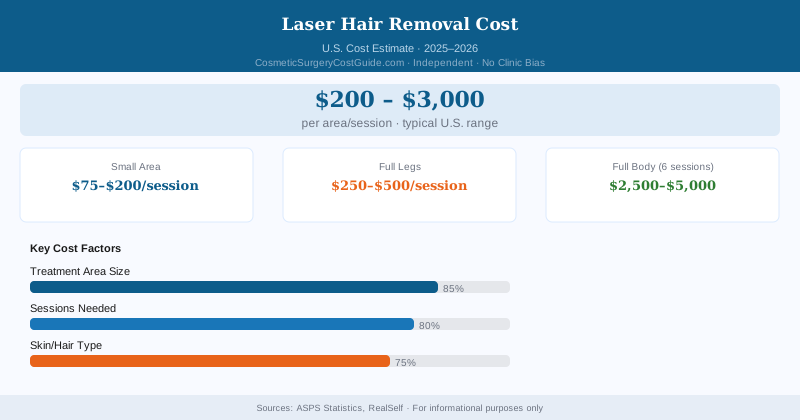
Laser hair removal is the second most-performed nonsurgical cosmetic procedure in the United States — only Botox surpasses it. The American Society of Plastic Surgeons reported over 1.1 million laser hair removal treatments performed in 2023 alone, and the number keeps climbing. That volume isn’t surprising. Do the math on a lifetime of waxing, and laser starts looking like the financially sensible option surprisingly fast.
But “laser hair removal costs $X” is almost meaningless without knowing the area, the number of sessions, and whether you’re walking into a med spa or a dermatology office. Here’s what the numbers actually look like.
Cost by body area — per session and full course
| Treatment Area | Cost Per Session | Sessions Needed | Full Course Total |
|---|---|---|---|
| Upper lip | $75–$150 | 6–8 | $450–$1,200 |
| Underarms | $100–$200 | 6–8 | $600–$1,600 |
| Bikini line | $150–$250 | 6–8 | $900–$2,000 |
| Brazilian (full pubic) | $200–$350 | 6–8 | $1,200–$2,800 |
| Lower legs | $250–$450 | 6–8 | $1,500–$3,600 |
| Full legs | $350–$800 | 6–8 | $2,100–$6,400 |
| Back (full) | $250–$500 | 6–8 | $1,500–$4,000 |
| Chest | $200–$400 | 6–8 | $1,200–$3,200 |
| Arms (full) | $200–$400 | 6–8 | $1,200–$3,200 |
| Face (full) | $250–$450 | 6–8 | $1,500–$3,600 |
How laser hair removal actually works — and why multiple sessions are required
A laser emits a concentrated beam of light that targets melanin (the pigment) in hair follicles. The energy heats the follicle and damages it enough to stop future hair growth. That’s the mechanism. Simple enough.
The complication is hair growth cycles. At any given time, only about 15–20% of your body hair is in the active growth phase (anagen) — the only phase where the follicle is connected to the blood supply and vulnerable to laser damage. The rest are in resting or shedding phases, sitting below the skin surface where they can’t be reached effectively. Each session catches a different batch of follicles cycling through their active phase.
That’s not a sales tactic. It’s just biology. Skipping sessions or spacing them too far apart lets follicles recover and reduces the cumulative effectiveness.
The lifetime cost comparison — laser vs. waxing
This is where laser hair removal’s value proposition becomes obvious for high-maintenance areas. Take full legs:
Full leg waxing: $80–$120 per session, every 4–6 weeks = roughly 9–10 sessions per year = $720–$1,200 per year. Over 10 years: $7,200–$12,000. Plus time.
Full leg laser: 8 sessions × $500 = $4,000 for the primary course. Annual touch-up: $500. Over 10 years: $8,500 — but with 70–90% reduction in hair, meaning most of those touch-ups aren’t needed. Realistic 10-year cost: $5,000–$6,000.
For Brazilian waxing ($50–$80 per session, monthly), the math is even more compelling. Laser pays for itself within 3–4 years of the primary course.
Nearly every laser hair removal provider offers packages — typically 6 or 8 sessions at 20–40% off single-session rates. This is a significant discount and almost always the right choice if you’re committed to completing a full course.
Example: underarms at $175/session × 8 sessions = $1,400 single-session pricing. An 8-session package often runs $900–$1,000 — saving $400–$500. Always ask about package pricing before booking your first session. Never pay single-session rates if you’re planning a full course.
Skin type and hair color candidacy — what actually works
Not everyone responds equally. The laser targets melanin — which means the contrast between hair color and skin tone matters enormously.
Ideal candidacy: Dark brown or black hair on lighter skin (Fitzpatrick I–III). High melanin in the hair, low melanin in the skin = the laser can target the follicle precisely without affecting surrounding tissue.
Darker skin tones (Fitzpatrick IV–VI): These patients absolutely need an Nd:YAG (1064nm) laser, which penetrates deeper and is much safer for melanin-rich skin. Alexandrite and IPL devices used on darker skin cause burns, hypopigmentation, and scarring. Fewer providers have this equipment — and fewer have genuine experience with it. Ask explicitly before booking.
Hair color: Dark brown and black hair respond best. Red hair responds poorly. Gray, white, and blonde hair doesn’t respond to laser at all — there’s insufficient melanin in the follicle to absorb the energy. If your hair is naturally blonde or gray, laser isn’t your solution.
Fine hair: More sessions required — sometimes 8–10. Fine hair absorbs laser energy less efficiently than coarse hair.
True laser vs. IPL — an important distinction
IPL (Intense Pulsed Light) is not a laser. It’s a broad-spectrum light source that’s less precise, less penetrating, and less effective than a true laser — especially for darker skin. Many med spas use IPL and call it “laser hair removal,” which is technically inaccurate.
The FDA has cleared specific laser devices (Alexandrite, diode, Nd:YAG, Ruby) for permanent hair reduction based on clinical evidence. IPL has less supporting evidence and significantly higher variability in results across providers.
If you’re paying for laser, ask what device they’re actually using. “IPL” is not the same as an Alexandrite or diode laser.
At-home devices — are they worth it?
Devices like the Tria Beauty Laser, Braun Silk Expert Pro, and Philips Lumea use lower-energy laser or IPL technology. They cost $300–$500 and can produce meaningful hair reduction for patients with light skin and dark hair.
What they can’t do: replicate clinical-grade results. Clinical lasers operate at significantly higher energy levels than any at-home device — the safety limits built into consumer devices reduce their effectiveness. Most users see 40–60% reduction after consistent use, compared to 70–90% with professional treatment. They’re also not appropriate for Fitzpatrick IV–VI skin tones.
For patients who aren’t candidates for professional treatment (wrong skin/hair type, budget constraints) or who want to extend professional results, at-home devices have a place. For everyone else, professional treatment delivers meaningfully better outcomes.
IPL and laser on darker skin tones without the appropriate device causes real harm — burns, permanent hypopigmentation (white spots), and scarring. This is a documented safety issue at budget laser centers using the wrong equipment. If you have medium-to-dark skin (Fitzpatrick IV–VI), do not book laser hair removal without confirming the provider uses an Nd:YAG laser and has documented experience with your skin type. A $99 groupon at a provider using the wrong device is not a bargain.
Where to get treatment — med spa vs. dermatologist vs. chain clinic
Chain laser centers (Ideal Image, Milan Laser, etc.): Competitive package pricing, often $1,000–$3,000 for multiple areas, with financing options. Standardized protocols work well for straightforward cases on lighter skin.
Medical spas with physician oversight: Similar pricing; more flexibility for nuanced cases.
Dermatologist or plastic surgery offices: Typically 20–40% premium over chain centers. Worth it for complex cases — darker skin, sensitive areas, or patients who’ve had poor results elsewhere.
Cost variation by geography: Practices in New York, LA, and San Francisco typically charge 30–50% more than national averages. If you’re willing to travel to a nearby mid-sized city, you can often save significantly without sacrificing quality.
“Permanent hair reduction” — what the FDA actually says
The FDA approves laser hair removal claims of “permanent hair reduction” — not permanent hair removal. The distinction matters. Permanent reduction means a significant, stable reduction in the number of hairs that regrow. It doesn’t mean zero hair, ever.
Most patients achieve 70–90% reduction that’s long-lasting. Some regrowth is normal, especially with hormonal changes (pregnancy, menopause, medications). Annual or bi-annual touch-up sessions ($100–$200 per small area) maintain results for most people over the long term.
Going in with realistic expectations means you won’t be surprised when you see a few hairs at 18 months — and you’ll know a simple touch-up session takes care of it.
Frequently Asked Questions
The FDA's approved term is 'permanent hair reduction' — not elimination. Most patients achieve 70–90% reduction after a full course of 6–8 sessions. Some hair regrowth is normal over time, particularly with hormonal changes. Annual or bi-annual touch-up sessions ($100–$200 each) maintain results for most people. Laser destroys active follicles, but it can't destroy follicles that weren't active during your treatment window.
6–8 sessions for most body areas, spaced 4–8 weeks apart. Hair grows in cycles, and a laser can only damage follicles during the active growth (anagen) phase — roughly 15–20% of follicles at any given time. Multiple sessions catch the rest as they cycle through. Fine or light hair may need 8–10 sessions. Hormonally driven facial hair (chin, upper lip in women with PCOS) often needs ongoing maintenance rather than a one-time course.
Yes — but it requires the right laser. Nd:YAG (1064nm) is the only device safe for Fitzpatrick IV–VI skin tones. Alexandrite and IPL devices on darker skin cause burns, hypopigmentation, and scarring. Fewer providers have Nd:YAG equipment and the training to use it properly on darker skin. If you have medium-to-dark skin, ask explicitly what laser they use and whether the provider has experience treating your Fitzpatrick type before booking.