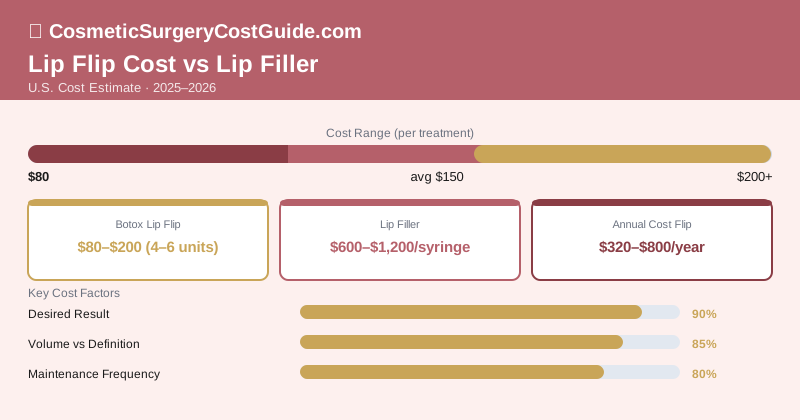
$80–$200 versus $600–$1,200. That’s the price gap between a lip flip and lip filler — and if you’ve been Googling both treatments without being totally sure which one you actually want, that price difference makes the decision feel urgent. But here’s the thing: choosing the cheaper option when you needed the other one costs you more in the end.
The lip flip and lip filler aren’t interchangeable. They serve almost entirely different purposes and produce fundamentally different results. According to ASAPS statistics, lip augmentation was the third most performed injectable procedure in 2023 with over 2.7 million treatments — and a significant portion of patients getting their first lip treatment are confused about which procedure does what. Getting that clarity upfront saves you money, a frustrating result, or both.
Lip flip vs. lip filler: cost at a glance
| Procedure | Cost Per Treatment | Maintenance Frequency | Annual Maintenance Cost |
|---|---|---|---|
| Botox lip flip | $80–$200 (4–6 units) | Every 2–3 months | $320–$1,200/year |
| Lip filler (1 syringe) | $600–$1,200 | Every 9–12 months | $600–$1,200/year |
| Combination (flip + filler) | $700–$1,400 | Flip every 2–3 mo; filler annually | $960–$2,400/year |
| Lip filler (0.5 syringe) | $300–$700 | Every 6–9 months | $400–$1,400/year |
Look at the annual numbers carefully. The lip flip’s low per-treatment price is appealing until you do the math: at $80–$200 every 2–3 months, you’re spending $320–$1,200 a year for a subtle effect. A single syringe of lip filler at $600–$1,200 lasts 9–12 months and produces more visible results. For patients who want real volume change, filler wins on cost-per-outcome over the full year.
The flip earns its place for patients who want a natural, barely-there enhancement — and who understand the functional trade-offs (more on those below).
What each procedure actually does
The lip flip uses 4–6 units of Botox injected into the orbicularis oris muscle along the upper lip border. Relaxing this muscle causes the upper lip to curl slightly outward, revealing more of the lip’s pink show (the visible portion of the lip surface). It doesn’t add volume. It changes how the lip sits at rest and during animation. The effect is deliberately subtle — friends won’t notice unless they’re looking for it — and it’s often described as the lips looking “naturally better.” It’s an excellent entry point for someone who has never done anything to their lips and isn’t sure how they feel about a more visible change.
Lip filler uses hyaluronic acid gel — Juvederm, Restylane, and their variants — injected directly into the lip tissue to add volume, shape, and definition. The result is visible, adjustable, and longer-lasting. A skilled injector can add volume proportionally, sharpen the vermilion border, create a more defined cupid’s bow, or add fullness to the lower lip while keeping everything looking natural — though heavy-handed technique produces exactly the opposite of that. The product and the injector’s eye for proportion matter equally here.
Because the lip flip relaxes the orbicularis oris — the circular muscle that controls the lips’ seal and precise movement — it can temporarily affect function in specific ways:
- Straws and water bottles: The lip seal needed to drink through a straw is weakened for 4–6 weeks after treatment. Spilling is genuinely common.
- Wind and brass instruments: Musicians who play instruments requiring precise lip pressure (trumpet, flute, French horn, oboe) should avoid lip flips entirely, or time them carefully with at least 3 months before any performance.
- Whistling: Usually not possible during peak effect.
- Enunciation: Some patients notice mild difficulty with specific consonants (P, B, M sounds require full lip seal) during the first 1–2 weeks.
These effects are temporary — they resolve as the Botox wears off over 2–3 months. But they’re worth knowing before you book if any of these things apply to your daily life.
Who should choose a lip flip vs. lip filler
Choose a lip flip if:
- Your upper lip disappears or curls inward when you smile
- You want the most subtle possible enhancement
- You’ve never had lip treatment and want to try enhancement before committing to filler
- You’re happy with your lip volume but want more visible pink show
Choose lip filler if:
- You want a visible volume increase
- You want more defined lip borders or a more prominent cupid’s bow
- You’re comfortable with a result others might notice
- You want longer time between maintenance appointments
Choose both if you want filler’s volume combined with the rolled-out show the flip creates — a half syringe of filler plus a flip can produce what previously required a full syringe, which can lower your annual filler cost.
See also: lip filler cost guide for a full breakdown of filler types, volume, and what to expect from a complete lip filler appointment.
Lip filler migration — where filler gradually spreads beyond the vermilion border — is a real complication, especially in patients who’ve had repeated treatments over many years. The upper lip is most vulnerable. Signs include a blurred or undefined lip border and a “shelf” appearance above the natural lip line. If you’re worried about migration, discuss it before adding more volume. If you already have migration, filler dissolving with hyaluronidase is the right correction step before adding anything new. Adding volume on top of migrated filler makes the problem worse, not better.
Bottom Line
A lip flip at $80–$200 per treatment is the lowest-cost entry point in cosmetic injectables, but the frequent maintenance schedule ($320–$1,200/year) reduces its cost advantage for patients with ongoing enhancement goals. Lip filler at $600–$1,200 per syringe lasts longer, delivers more visible results, and is the right choice when actual volume is what you’re after. The flip earns its place for subtle upper lip enhancement, improved animation, and as a smart complement to filler. Know the functional limitations before booking — and choose a provider whose before-and-after portfolio shows a consistently light, natural touch.