Forty years in the aesthetic industry is a long time to stick around. Microdermabrasion has been a staple since 1985 — not because it’s flashy, but because it reliably does what it promises: brightens dull skin, smooths surface texture, fades mild hyperpigmentation, and preps your skin to absorb serums more efficiently. The ASPS consistently lists it among the top five minimally invasive procedures by volume each year, with nearly 600,000 treatments performed annually in the US.
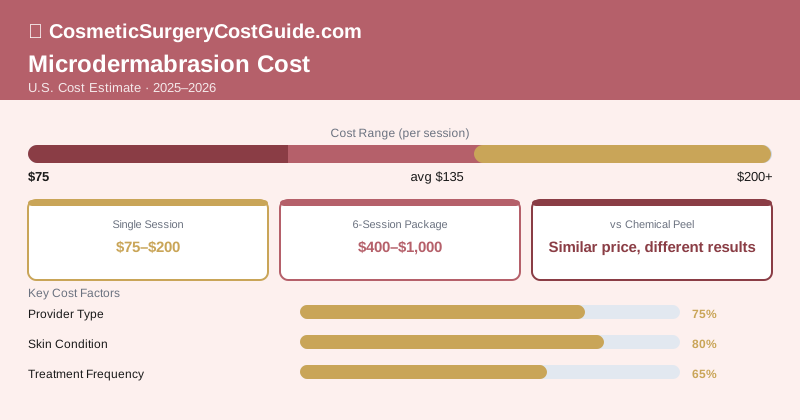
At $75–$200 per session, it’s also one of the most accessible entry points in professional skincare. What it won’t do is correct anything structural — deep wrinkles, significant laxity, or scarring that lives in the dermis. Knowing where its strengths end is just as important as knowing where they begin.
Microdermabrasion pricing
| Service | Price Range | Notes |
|---|---|---|
| Single session (med spa) | $75–$200 | Standard 30–45 min treatment |
| Single session (dermatologist office) | $150–$300 | Higher overhead, clinical setting |
| 6-session package | $400–$1,000 | Average 20–25% discount vs single sessions |
| Facial with microdermabrasion add-on | $100–$250 | Combined service; often the best value |
| Diamond microdermabrasion | $100–$250 | Diamond-tip wand; no crystals |
| Crystal microdermabrasion | $75–$175 | Traditional; crystals occasionally irritating |
| Back or chest treatment | $100–$200 | Less common; effective for body acne/texture |
Med spa pricing is lower than dermatologist office pricing not because the procedure is different but because the overhead structure is different. The same basic physics at a dermatology practice costs more to deliver because you’re paying for the clinical infrastructure. For most patients, a med spa with a licensed esthetician is entirely appropriate. The clinical setting matters more if you have skin sensitivities, a history of unusual reactions, or an underlying condition that warrants physician oversight.
Diamond vs. crystal: does the type matter?
Traditional microdermabrasion sprays fine aluminum oxide crystals across the skin while simultaneously vacuuming away exfoliated cells and used crystals. Diamond-tip microdermabrasion replaces the crystals with a diamond-encrusted wand that abrades mechanically, without loose particles flying around.
In practice, the outcomes are comparable. Diamond-tip has become the more common choice because there’s no inhalation risk from crystals, no stray particles near your eyes, and the provider controls depth by adjusting pressure and speed rather than crystal volume. Both achieve the same goal: controlled removal of the outermost stratum corneum cells. If your med spa offers diamond-tip, that’s usually the better option — not because of dramatically different results, but because it’s more comfortable and slightly more precise.
Microdermabrasion is effective for:
- Surface texture irregularities — rough or uneven skin surface responds well to mechanical exfoliation
- Mild hyperpigmentation — sun spots and post-inflammatory marks in the superficial epidermis can fade with a series of treatments
- Clogged pores and blackheads — particularly effective when combined with extractions
- Dull, lackluster complexion — removal of the outer cell layer immediately brightens appearance
- Keratosis pilaris (rough bumps on arms/thighs) — effective as a body treatment
Microdermabrasion is NOT effective for:
- Deep wrinkles or significant skin laxity — the treatment reaches only the stratum corneum, not the dermis
- Active cystic acne — abrasion spreads bacteria and worsens active breakouts
- Deep acne scarring (ice pick, boxcar) — requires deeper resurfacing
- Melasma — superficial exfoliation can temporarily improve appearance but often triggers rebound pigmentation
Microdermabrasion vs. the alternatives
The most common comparison is microdermabrasion versus chemical peels and microneedling.
Chemical peels ($100–$800 depending on depth) work through chemical exfoliation rather than mechanical abrasion. A superficial peel at $100–$200 is roughly comparable to microdermabrasion in depth and results — either works for texture and mild pigmentation, and it often comes down to personal preference. Medium-depth peels at $250–$600 treat concerns that microdermabrasion can’t touch: moderate wrinkles, actinic keratoses, more significant sun damage. If your concerns fall in that deeper category, step up to a chemical peel.
Microneedling ($200–$700 per session) works entirely differently — it creates micro-injuries in the dermis to stimulate collagen production. For acne scarring, fine lines, and skin tightening, microneedling is substantially more effective than microdermabrasion. The tradeoff is 1–3 days of downtime versus essentially zero with microdermabrasion.
For brightening, maintenance, and prep — microdermabrasion earns its place. For correcting structural skin changes, you need a modality that goes deeper.
Avoid microdermabrasion if you have active cold sores, active inflammatory acne, rosacea with active flushing, eczema, psoriasis, or if you’ve used isotretinoin (Accutane) within the past 6 months. Active skin conditions and recent retinoid use elevate the risk of irritation, infection, and prolonged recovery. Also skip it right before sun exposure — freshly exfoliated skin burns faster and pigments unevenly with UV. Use SPF 30+ for at least a week after every session.
Is a package worth it?
Most practices offer 6-session packages at 15–25% off per-session pricing. For patients addressing texture, dullness, or mild pigmentation, a series of 4–6 treatments spaced 2–4 weeks apart produces noticeably better results than a single session. If you’ve done one session and liked the results, committing to a package is typically the right call.
For patients primarily using it as monthly maintenance between more intensive treatments — peels, laser, microneedling — single sessions as needed offer more flexibility without a big upfront commitment.
Bottom Line
Microdermabrasion at $75–$200 per session is one of the more accessible entry points in professional aesthetics. It’s reliably effective for surface-level concerns: texture, mild pigmentation, dullness, and skin prep. It won’t correct what’s happening in the dermis — for wrinkles, scarring, or significant laxity, invest in a deeper modality. But as a regular maintenance treatment or as an introduction to professional skincare, its low downtime and modest cost make it genuinely worth the appointment.