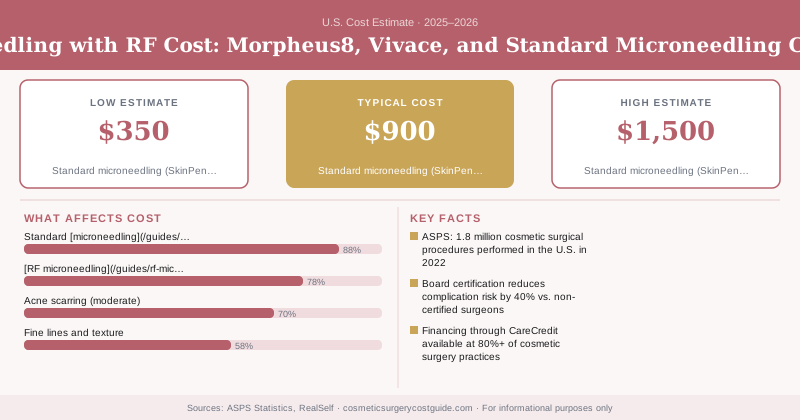
Sarah, 38, went in for a microneedling quote and walked out with two options: $350 per session for standard microneedling, or $1,400 per session for Morpheus8 (radiofrequency microneedling). She had no idea how to evaluate the difference. Her friend swore by Morpheus8. Her dermatologist said standard microneedling was fine for her skin concerns. Both were right — for different reasons.
The microneedling category has expanded dramatically. Here’s what actually separates these devices, what each costs, and when the upgrade is clinically justified.
Pricing comparison across microneedling types
| Treatment | Average Cost Per Session | Typical Series (3 sessions) | Downtime |
|---|---|---|---|
| Standard microneedling (SkinPen, Dermapen) | $350 | $900–$1,500 | 24–48 hrs |
| Microneedling + PRP (vampire facial) | $650 | $1,500–$2,500 | 48–72 hrs |
| RF microneedling — entry level (Profound) | $900 | $2,400–$3,600 | 3–5 days |
| RF microneedling — Vivace | $1,000 | $2,700–$4,000 | 2–4 days |
| RF microneedling — Morpheus8 | $1,400 | $3,500–$5,500 | 3–7 days |
| RF microneedling — Secret RF | $1,100 | $2,800–$4,200 | 2–5 days |
The American Academy of Dermatology cites microneedling as one of the most evidence-supported minimally invasive skin rejuvenation treatments, with controlled studies showing statistically significant improvement in acne scarring, fine lines, and skin texture after a standard 3-session protocol.
Standard microneedling vs. RF microneedling: what’s actually different
Standard microneedling creates controlled micro-injuries in the dermis using fine needles. The injury response triggers fibroblast activation and collagen synthesis. It’s effective for surface-level texture, mild acne scarring, hyperpigmentation, and fine lines. Needle depth ranges from 0.5mm to 2.5mm depending on treatment area and concern.
RF microneedling adds radiofrequency energy delivered at the needle tip, heating the deep dermis (2–4mm depth) and subcutaneous tissue. This dual mechanism produces stronger collagen remodeling and, importantly, tissue tightening — something standard microneedling doesn’t achieve. It’s this tightening effect that makes RF microneedling particularly effective for mild to moderate skin laxity.
- Acne scarring (moderate): Standard microneedling or microneedling + PRP — well-supported by evidence, lower cost for a full series
- Fine lines and texture: Standard microneedling delivers good results; RF upgrade adds minimal benefit for surface-only concerns
- Skin laxity / mild jowling: RF microneedling (Morpheus8, Vivace) — the RF energy drives tightening that standard needles can’t replicate
- Deep acne scarring or significant laxity: Consider consulting on fractional CO2 laser or surgical options — RF microneedling has a ceiling
- Under-eye concerns: Not all RF devices are cleared for the orbital area — ask specifically
The Morpheus8 premium: is it justified?
Morpheus8 is the best-marketed RF microneedling device, and it commands a price premium — often $300–$500 more per session than comparable RF devices. The clinical differentiation: Morpheus8 uses fractional RF with up to 8mm needle depth and adipose (fat layer) remodeling capability, making it effective for body contouring as well as facial rejuvenation.
A 2021 prospective study in Lasers in Surgery and Medicine found Morpheus8 produced significant improvements in facial skin laxity scores at 3 months post-treatment, with results continuing to improve through 6 months. The technology is legitimate. Whether the price premium over Vivace or Secret RF is clinically justified in your specific case depends on needle depth requirements — your provider should explain whether deeper RF delivery is actually warranted for your concerns.
ASPS data on the growth of energy-based treatments
The ASPS reported a 15% year-over-year increase in energy-based skin treatments in 2023, with RF microneedling being the fastest-growing subcategory. Much of this growth is driven by patients seeking skin-tightening results without surgical downtime — RF microneedling occupies a unique position between a light peel ($150) and a surgical facelift ($8,000–$15,000).
How many sessions do you need?
For standard microneedling, the evidence-backed protocol is 3 sessions spaced 4–6 weeks apart, followed by annual maintenance. For RF microneedling, most providers recommend 1–3 sessions depending on the device and concern — Morpheus8 often achieves meaningful results in 1–2 sessions because of its deeper tissue impact.
Microneedling of any type is not appropriate for active acne breakouts, open wounds, or rosacea flares. RF microneedling is contraindicated in patients with pacemakers, implanted metal in the treatment area, or during pregnancy. Disclose all medical history, implants, and current skin conditions before your appointment.
What to ask before booking
Don’t just ask “how much is microneedling?” Ask your provider which device they use, what needle depth they plan for your concern, whether RF is clinically indicated in your case, and what the realistic results timeline looks like. A provider who can answer all four questions confidently is worth the extra consultation fee.