Medically necessary vs. purely cosmetic: that one distinction changes almost everything about mole removal — whether insurance pays, which method a doctor uses, and whether a biopsy goes to the lab. Get this wrong and you could pay out of pocket for something your insurance would’ve covered. Or worse, skip the dermatologist entirely and use a method that destroys tissue that should’ve been examined.
Here’s what you need to know about cost, method, and when each applies.
Mole Removal Cost
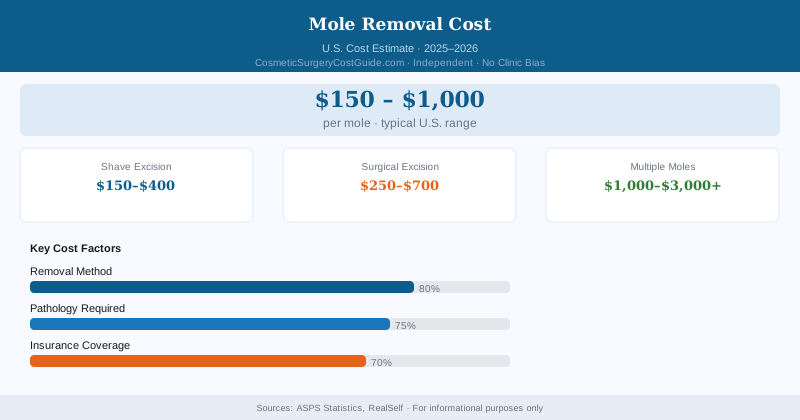
| Method | Cost Per Mole | Best For |
|---|---|---|
| Shave excision | $150–$400 | Raised, benign moles; quick removal |
| Surgical excision (with sutures) | $200–$500 | Deeper moles; suspicious lesions |
| Laser removal | $200–$600 | Flat, pigmented moles; non-suspicious |
| Electrosurgery/cauterization | $150–$300 | Small, benign raised moles |
| Cryotherapy | $100–$250 | Flat pigmented spots (seborrheic keratoses) |
| Pathology (required if suspicious) | $50–$200 additional | When sent to lab for analysis |
When Insurance Covers Mole Removal
Insurance covers mole removal when there’s documented medical necessity — specifically, when the mole is:
- Suspicious for melanoma or dysplasia: Any asymmetric, irregular-bordered, multi-colored, or changing mole
- A confirmed atypical nevus: Dermatologist-identified dysplastic moles warrant removal
- Functionally problematic: A mole that repeatedly bleeds, catches on clothing, or creates practical issues
Insurance typically requires biopsy and pathology submission (sending the tissue to a pathologist). The dermatologist’s exam and documentation of the medical indication must be in your chart.
Use the ABCDEs of melanoma detection:
- Asymmetry: One half doesn’t match the other
- Border: Irregular, ragged, or blurred edges
- Color: Multiple colors (brown, black, red, white, blue)
- Diameter: Larger than 6mm (about the size of a pencil eraser)
- Evolving: Any change in size, shape, color, or new symptoms
Any mole meeting any of these criteria warrants a dermatologist appointment before removal. Never have a suspicious mole removed by laser (which destroys the tissue) or any method without pathological examination of the specimen.
Shave Excision: The Most Common Method
For raised, soft moles that are clearly benign, shave excision is efficient: a scalpel shaves the mole flush with or just below the skin surface. No sutures required. It heals in 1–2 weeks, leaving a small flat scar that’s usually minimal.
The removed tissue can still be sent for pathology, which makes this both a cosmetic and medically thorough approach. The AAD recommends pathology submission whenever there’s any doubt about a lesion — even after a straightforward-looking shave.
Surgical Excision: For Deeper or Suspicious Moles
Surgical excision removes the mole and a margin of surrounding skin, then closes with sutures. It’s required for:
- Deep moles that extend significantly below the surface
- Any mole that’s suspicious (needs margins for pathology)
- Large moles
The result is a thin line scar rather than the circular scar from shave excision. In skilled hands on appropriate locations, these scars fade well over time.
Laser Mole Removal: Limitations Matter
Laser (typically CO2 or Nd:YAG) can vaporize small, flat pigmented moles and seborrheic keratoses. Here’s the critical limitation: the tissue is destroyed, not preserved — so pathology cannot be performed. Laser removal is only appropriate for moles that have already been evaluated by a dermatologist and confirmed as benign.
Anyone offering to laser-remove a mole without prior dermatologist evaluation is not following appropriate safety protocols. Full stop.
Never remove a suspicious or unevaluated mole by laser, cauterization, or at-home methods. If a mole is malignant and the specimen is not preserved for pathology, the diagnosis will be missed — potentially allowing melanoma to spread while you’re unaware. Get any changing, symptomatic, or suspicious mole evaluated by a board-certified dermatologist before any removal method is used. This takes a single appointment and could literally save your life.
DIY and Aesthetic Spa Mole Removal
Online products and aesthetic spas offering mole removal without dermatologist involvement should be avoided for any mole that hasn’t been evaluated. An unevaluated mole removed by a non-medical provider could mask a melanoma diagnosis. For clearly cosmetic removal of moles already cleared as benign, experienced aesthetic providers can perform straightforward removals.
Multiple Mole Removal: Cost Efficiency
If you’re having multiple benign moles removed at the same visit, many dermatologists discount additional moles:
- First mole: $200–$400
- Each additional mole: $75–$200
Scheduling all cosmetic mole removal in a single appointment maximizes efficiency and typically reduces per-mole cost.
What to Expect After Removal
- Shave excision: Small pink/red flat area heals in 1–3 weeks
- Surgical excision: Sutures out in 5–14 days depending on location; thin scar fades over 12 months
- Wound care: Antibiotic ointment and bandage for first 1–2 weeks
Bottom Line
Cosmetic mole removal by a dermatologist: $150–$400 per mole using shave excision, the most common approach. Multiple moles at one visit typically reduce the cost per mole. Insurance covers removal of any mole with documented medical indication — so always have suspicious moles evaluated for coverage before assuming you’ll pay out of pocket. Never remove an unevaluated mole by laser or non-medical methods.