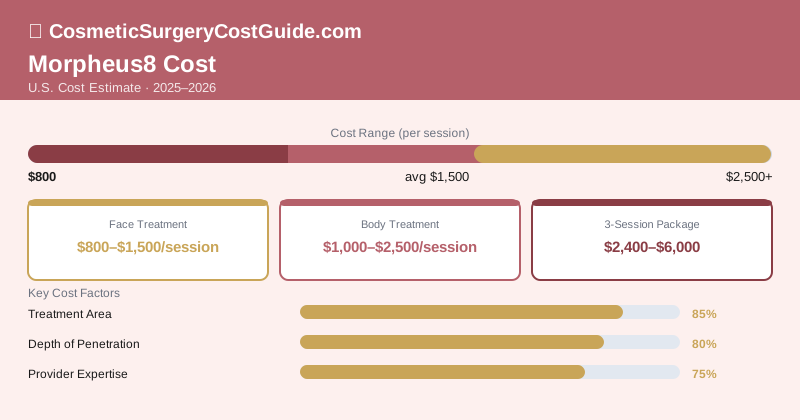
Standard RF microneedling runs $300–$800 a session. Morpheus8? Face treatments start at $800 and can hit $1,500; body work goes up to $2,500. That’s not a small gap. And if you’ve noticed Morpheus8 showing up everywhere from Beverly Hills clinics to your local med spa’s Instagram feed, you’ve probably already asked yourself: is the premium actually worth it, or is this just marketing?
Honest answer: it depends entirely on what you’re treating. According to the American Society of Plastic Surgeons, non-surgical skin tightening procedures saw a 23% increase between 2020 and 2023 — and Morpheus8 has been one of the biggest drivers of that growth. But this isn’t just a fancier version of regular microneedling. The device operates at a fundamentally different depth and targets tissue that standard devices can’t reach. For the right candidate, the price difference pays off. For the wrong one, you’re overpaying for marginal results.
Morpheus8 pricing by treatment area
| Treatment Area | Cost Per Session | Typical Sessions Needed | Total Package Cost |
|---|---|---|---|
| Face (full) | $800–$1,500 | 3 | $2,400–$4,500 |
| Neck | $600–$1,200 | 3 | $1,800–$3,600 |
| Face + neck combined | $1,200–$2,200 | 3 | $3,600–$6,600 |
| Abdomen | $1,000–$2,500 | 3 | $3,000–$7,500 |
| Arms (upper) | $800–$1,800 | 3 | $2,400–$5,400 |
| Inner thighs | $1,000–$2,000 | 3 | $3,000–$6,000 |
| Jawline / jowls (targeted) | $600–$1,000 | 2–3 | $1,200–$3,000 |
Geography moves these numbers significantly. In Los Angeles, Miami, and New York, you’re almost always paying at the upper end. Smaller markets and practice-owned med spas typically run 20–30% lower. Board-certified plastic surgeons and dermatologists charge more than nurse practitioners at standalone med spas — not always because the outcome is better, but because the clinical infrastructure costs more to run.
What Morpheus8 does that standard RF microneedling doesn’t
Standard RF microneedling devices like Vivace, Sylfirm X, and Secret RF penetrate roughly 1.5–3.5mm, targeting the dermis. That’s genuinely effective for texture, pore size, and mild tightening. Morpheus8 uses 24-pin bipolar RF needles that go to 4–8mm — all the way into the subdermal fat layer.
That depth is everything. When RF energy heats fat tissue at that level, it triggers partial fat cell destruction (lipolysis) alongside collagen remodeling in the deeper reticular dermis. The result is dual-action: skin tightening from above, mild contouring from below. It’s not liposuction — no device is — but for patients with mild laxity, early jowling, or loose skin after weight loss or pregnancy, it produces results that surface-level devices simply can’t touch.
InMode’s Morpheus8 is FDA-cleared for subdermal adipose tissue remodeling. A 2021 study in Lasers in Surgery and Medicine found statistically significant improvement in skin laxity scores at 3 months post-treatment, with minimal downtime across study participants.
Morpheus8 performs best on patients who have:
- Mild to moderate skin laxity — not severe sagging that requires surgical correction
- Early jowling or softening jawline definition
- Loose skin on the abdomen or arms following weight loss or post-pregnancy
- Acne scarring (particularly atrophic, rolling scars)
- Fitzpatrick skin types I–VI — unlike ablative lasers, Morpheus8 is safe for darker skin tones because it bypasses the epidermis
It is NOT a good fit for patients with significant excess skin that would require excision, active cystic acne in the treatment zone, or realistic expectations for surgical-level results.
Downtime and what the recovery actually looks like
Three to five days of redness, swelling, and pinpoint bruising is typical. The needles create micro-injuries at depth, so you’ll look like a moderate sunburn for the first 48 hours, followed by some flaking or peeling. Most people are back to normal social life by day five. Full results? Those come in over 3–6 months as collagen remodeling does its work — so don’t judge the treatment in week two.
Body treatments produce more swelling than facial ones. Abdominal Morpheus8 in particular can feel tender for 3–7 days. Plan your timing if you have events coming up or if you travel for work.
Morpheus8 isn’t appropriate right before or after significant sun exposure. Even though the device is generally safe for darker skin tones, tanned skin raises the risk of post-inflammatory hyperpigmentation. Avoid direct sun for 2 weeks pre-treatment and use SPF 30+ consistently for 4 weeks post-treatment. If a provider doesn’t ask about your sun exposure history before booking, that’s a red flag worth paying attention to.
Is Morpheus8 worth the cost versus alternatives?
A few honest comparisons at similar price points:
Ultherapy uses focused ultrasound to heat the SMAS layer — excellent for significant lifting but typically more discomfort, longer recovery, and comparable pricing ($2,000–$5,000 full face). Morpheus8 generally wins on downtime and versatility. Thermage uses monopolar RF without needles — less downtime but less depth, and generally considered less effective for significant laxity. One session runs $1,500–$4,500.
Standard RF microneedling costs $300–$800 per session and handles texture, pores, and early fine lines well. If those are your only concerns, Morpheus8’s premium probably doesn’t pay off. But if you’re dealing with early jowling or loose skin that needs to be addressed at the subdermal level, it’s a different conversation entirely.
Bottom Line
Morpheus8’s $800–$1,500 per session is justified when the goal is subdermal remodeling — early jowling, loose post-weight-loss skin, or moderate laxity that needs deep-penetration treatment. For straightforward surface concerns like texture and pores, standard microneedling gets the job done at a fraction of the price. Get quotes from at least two board-certified providers, confirm they’re using the authentic InMode device (not a knockoff), and ask to see before-and-after photos of real patients with similar concerns — not the brand’s curated marketing images.