She came in for a facelift consultation. She was 55, had done everything right — sunscreen, retinol, no smoking — and her face honestly looked pretty good. The surgeon agreed. But then he handed her a mirror and asked her to look at her neck.
The vertical cords running down toward her collarbone. The loose skin collecting just below her chin. The blurred jaw angle that used to be sharp. That’s where the years had actually gone.
“Your face is fine,” he told her. “Your neck is what’s aging you.”
It’s a conversation plastic surgeons have constantly. The neck is often the first area to show age — and the area most patients aren’t watching closely until someone points it out. A well-executed neck lift can dramatically change how a face reads, without a single stitch on the face itself.
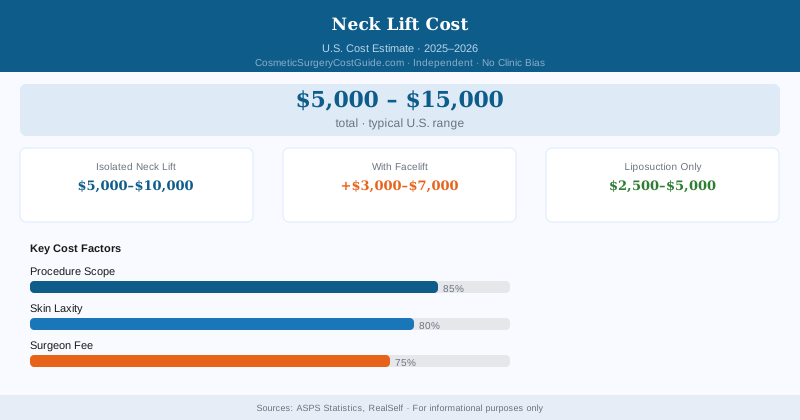
What does a neck lift cost?
| Component | Cost |
|---|---|
| Surgeon fee | $5,000–$8,000 |
| Anesthesia | $1,000–$2,000 |
| Facility fee | $1,000–$2,500 |
| Total (standalone neck lift) | $5,000–$9,000 |
| Combined lower facelift + neck lift | $8,000–$18,000 |
| Neck liposuction only (younger patients) | $2,000–$4,000 |
| Kybella (non-surgical fat only) | $1,200–$1,800 |
The American Society of Plastic Surgeons 2023 statistics report that the average surgeon’s fee for a neck lift is approximately $5,774 — but that number excludes anesthesia, facility fees, and pre/post-care costs, so the all-in figure is considerably higher. ASPS data also confirms neck lifts rank consistently among the top five surgical facial rejuvenation procedures performed annually in the US, reflecting how common the concern is.
Cervicoplasty vs. platysmaplasty — what’s the actual difference?
Most patients hear “neck lift” as one thing. It’s not. There are two distinct components, and your anatomy determines which one — or both — you actually need.
Cervicoplasty is the skin-removal component. The surgeon excises excess skin from the neck and re-drapes the remaining skin tighter. Incisions run behind the ears and sometimes under the chin. It addresses loose, sagging skin — the “wattle” effect — but it doesn’t touch the underlying muscle.
Platysmaplasty is the muscle-tightening component. The platysma is a thin, sheet-like muscle that runs from the jaw down to the chest. With age, the muscle edges separate and the medial borders become visible as vertical bands — those cords you see in the front of the neck when you tense up, sometimes called platysmal banding. Platysmaplasty involves surgically tightening those muscle edges together (called corset platysmaplasty) through a small incision under the chin. This is what creates a defined jaw angle and eliminates the banding.
The dramatic before-and-after results you see in neck lift photos? That’s almost always the platysmaplasty working — not just skin removal.
Who needs what — matching the procedure to the anatomy
Not everyone needs the full menu. Age, skin quality, and underlying anatomy all factor into what’s actually required.
Younger patients (30s–early 40s) with good skin elasticity: If the concern is mainly a fat pocket under the chin with no visible skin laxity, submental liposuction alone ($2,000–$4,000) can be a genuinely good solution. The surgeon removes fat through a tiny cannula under the chin. Recovery is 1–2 weeks and scarring is minimal. When skin snaps back on its own, results are excellent.
Mid-40s to 60s with skin laxity: When skin doesn’t recoil after liposuction — or when it’s already loose — cervicoplasty (skin removal) is added. Liposuction is usually done at the same time to address any submental fat.
Full banding plus skin laxity and wattling: Loose skin, visible platysmal bands, submental fat, a blurred jaw angle — this is the complete picture. All three components are needed: liposuction, cervicoplasty, and platysmaplasty. This is also typically when surgeons recommend combining the neck lift with a lower facelift, since the structures are anatomically connected and the results are more harmonious.
Surgeons often recommend combining a neck lift with a lower facelift — not to upsell, but because of anatomy. The platysma muscle extends upward into the lower face, and jowls create a visual disconnect if the neck is tightened but the jaw remains soft. Doing both in one operation means one anesthesia event, one recovery, and a more cohesive result. The combined procedure costs more ($8,000–$18,000) but typically delivers a more complete transformation than two separate operations would.
The liposuction component
Submental liposuction is almost always part of a neck lift when meaningful fat is present. Fat removal ($2,000–$4,000 as a standalone, or built into the combined cost) typically happens through a small stab incision under the chin before or during the skin and muscle work. Without removing the fat first, skin tightening produces a tight, lumpy result rather than smooth contour. The lipo and the lift work together — it’s not really optional when fat is present.
Kybella as a non-surgical option
Kybella (deoxycholic acid) is an FDA-approved injectable that destroys fat cells under the chin. It takes 2–3 treatment sessions ($600–$900 each) and costs $1,200–$1,800 for a full treatment course.
What it can’t do: tighten skin, address platysmal banding, or improve a blurred jawline caused by laxity. If you’re in your 30s with a single fat pocket and firm skin, Kybella might genuinely get you to a satisfying result. If you’re 50 with banding and loose skin, you’ll spend $1,500 and still need surgery.
A board-certified surgeon can tell you in a consultation which path makes sense for your anatomy specifically.
Recovery timeline
The recovery from a neck lift is less intense than a full facelift but still requires real downtime.
- Chin strap compression garment: Worn 24/7 for 1–2 weeks, then at night for 1–2 additional weeks. This is non-negotiable — it prevents fluid accumulation and supports new contours as they heal.
- Swelling and bruising: Significant for the first 2 weeks. Most patients are comfortable going out in public by weeks 2–3 with concealing makeup.
- Final result: 3–6 months for swelling to fully resolve. The result at 2 weeks looks different from the result at 6 months — don’t judge the outcome early.
- Work return: Most patients return to desk work in 10–14 days. Physical labor, exercise, and bending/straining: 4–6 weeks.
Smoking dramatically increases the risk of poor outcomes after a neck lift. Nicotine constricts blood vessels, impairs wound healing, and raises the risk of skin necrosis and visible scarring. ASPS safety guidelines recommend that surgeons require patients to stop smoking at least 4–6 weeks before and after surgery. Many board-certified surgeons will decline to operate on active smokers. If you smoke, this is worth taking seriously — it’s not just a disclaimer.
How long do results last?
A well-executed neck lift typically lasts 8–10 years before patients consider revision or complementary treatments. This isn’t a guarantee — it depends on skin quality at the time of surgery, sun habits afterward, and the natural pace of your aging. Patients who are older at the time of surgery or have very thin, sun-damaged skin may see results fade faster. Non-surgical maintenance (skin care, Ultherapy, occasional filler) can extend the visual result without additional surgery.
Finding the right surgeon
The neck is a technically demanding area with important structures — the external jugular vein, the marginal mandibular nerve, the platysma itself — that require genuine facial anatomy expertise. Look specifically for:
- Board certification by the American Board of Plastic Surgery (ABPS) or American Board of Facial Plastic and Reconstructive Surgery (ABFPRS)
- A before-and-after gallery showing neck lift results specifically, not just general face work
- A surgeon who distinguishes between cervicoplasty and platysmaplasty and explains which your anatomy requires
- A consultation where the surgeon recommends what you actually need — not necessarily the most extensive procedure
Frequently Asked Questions
No — a standalone neck lift addresses only the area from the chin to the clavicle. The incisions are typically behind the ears and under the chin. If you want improvement to the lower face and jowls at the same time, you'd need a combined lower facelift and neck lift, which runs $8,000–$18,000. Many surgeons recommend doing both in one operation since the structures are anatomically connected.
Typically 8–10 years. A neck lift doesn't stop the aging process, but it resets the clock significantly. Patients who stay out of the sun, don't smoke, and maintain a stable weight tend to get the longest-lasting results. Significant weight fluctuation after surgery can affect the outcome more than age alone.
Kybella works for submental fat — but only fat. It destroys fat cells under the chin over 2–3 treatments ($1,200–$1,800 total), but it does absolutely nothing for loose skin or platysmal banding. If your concern is purely a fat pocket with good skin elasticity, Kybella or liposuction alone might be enough. If you have skin laxity, vertical muscle cords, or wattling, you'll need a surgical neck lift.