Picture this: you’ve wanted to address your inverted nipples for years, but you’ve never quite gotten around to asking a surgeon about it because it feels like a strange thing to bring up. You’re not alone. According to the American Society of Plastic Surgeons (ASPS), nipple and areola procedures are among the most commonly delayed cosmetic requests — not because they’re complicated, but because patients feel awkward raising the subject.
Here’s the thing: surgeons hear this all the time. These are common, well-established procedures with high satisfaction rates and genuinely simple recoveries. A grade 1 inversion correction takes about 30 minutes under local anesthesia. You’re in and out the same morning.
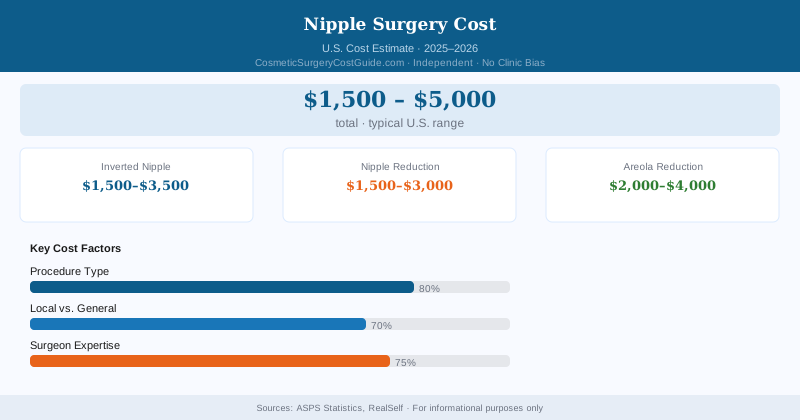
Procedures run from that 30-minute office visit all the way up to areola reduction combined with breast lift. The costs vary quite a bit depending on what you need.
Nipple Surgery Cost by Procedure
| Procedure | Cost Range | Anesthesia | Downtime |
|---|---|---|---|
| Nipple inversion correction (grade 1–2) | $1,500–$3,000 | Local | 2–3 days |
| Nipple inversion correction (grade 3) | $2,500–$4,500 | Local/IV sedation | 3–5 days |
| Nipple reduction (oversized nipples) | $1,500–$3,000 | Local | 2–3 days |
| Areola reduction | $2,000–$3,500 | Local | 3–5 days |
| Nipple + areola reduction (combined) | $2,500–$4,500 | Local/IV sedation | 3–5 days |
| Supernumerary nipple removal | $500–$1,500 | Local | 1–2 days |
| Nipple reconstruction (post-mastectomy) | $2,000–$5,000 | Local | 5–7 days |
| 3D nipple tattooing (post-mastectomy) | $300–$800 | None | None |
Nipple Inversion Correction
Inverted nipples — the ones that retract inward rather than projecting outward — are classified by severity, and the grade determines both how the correction works and what it costs.
Grade 1: You can pull it out manually and it stays out. This is the easiest to fix. The surgeon does minimal duct release, which means most breastfeeding function is preserved.
Grade 2: Pulls out but immediately retracts. Needs more tissue release. Still very manageable.
Grade 3: Won’t come out manually at all. Requires significant duct release; breastfeeding ability is usually compromised after this procedure. If future breastfeeding matters to you, have a direct conversation with your surgeon before going ahead.
The whole thing happens under local anesthesia in an office or surgical suite, takes 30–60 minutes, and recovery is minimal. You’ll likely be sore for a few days and told to avoid compression on the area.
For patients who plan to breastfeed in the future, Grade 1 corrections have the best chance of preserving function — the limited duct release still allows many women to breastfeed successfully. Grade 3 corrections require cutting the milk ducts and typically preclude breastfeeding. If breastfeeding is a priority, discuss this explicitly with your surgeon before the procedure.
Congenital inversion also sometimes corrects on its own during pregnancy — it may be worth waiting if pregnancy is in your immediate plans.
Nipple Reduction
Nipple reduction addresses the projecting tip itself — not the areola. They’re completely separate procedures, and it’s worth knowing the difference before your consultation.
If your nipples are enlarged or elongated, a surgeon removes excess tissue and reshapes the projection in a minor outpatient procedure. About 45 minutes under local anesthesia. Stitches dissolve or come out in 1–2 weeks. Sensation is generally preserved, which is something most patients ask about immediately.
Areola Reduction
The areola — the pigmented circle surrounding the nipple — can be reduced by making an incision around its outer edge, removing that outer ring of tissue, and suturing the smaller areola to the surrounding breast skin. The scar sits right at the color transition line, so it hides pretty well.
This is one of the most common components of a breast lift, but it also works as a standalone procedure for patients who don’t need a full lift.
One thing to know: some temporary numbness in the nipple-areola complex is common after this procedure. Permanent sensation change is less likely but possible. Ask your surgeon directly about their patient rates on this.
Procedures After Mastectomy
If you’ve had a mastectomy covered by insurance, nipple reconstruction falls under the Women’s Health and Cancer Rights Act (WHCRA) mandate — meaning insurance must cover it. See our breast reconstruction article for the full picture.
Two options exist for restoring the nipple after mastectomy and reconstruction:
Surgical nipple reconstruction: A small skin flap from the reconstructed breast creates a physical projection. Thirty to sixty minutes under local anesthesia. A follow-up areola tattoo session 2–3 months later adds color and completes the look.
3D nipple tattooing: A specialized medical tattoo — using shading and perspective — that creates a realistic-looking nipple without any physical projection. The visual result at normal viewing distance is remarkably convincing. Some insurers cover this under WHCRA. Done by specialized medical tattoo artists or nurses with tattoo training.
Be cautious about any nipple or areola procedure performed in a non-sterile environment. These procedures require proper surgical setup, sterile technique, and a provider trained in the relevant anatomy. While minor nipple correction is often described as a simple office procedure, it should still be performed in a setting with appropriate equipment for managing the rare complication.
When Nipple Surgery Is Combined with Other Procedures
Areola reduction almost always happens as part of a breast lift — the lift’s incisions naturally accommodate the resizing. If you’re having a breast lift, ask your surgeon ahead of time what size they’re planning for your areola. Don’t leave that detail to be decided mid-surgery. Bring it up in your consultation, put it in your notes, and confirm at your pre-op.
Adding nipple or areola work during breast augmentation typically costs $500–$1,500 more than augmentation alone — a relatively small add-on for something patients often wish they’d addressed at the time.
Bottom Line
For most standalone nipple and areola procedures: budget $2,000–$4,500 under local anesthesia at an outpatient setting. More complex grade 3 inversion correction or combined procedures run $3,500–$5,500. When done as part of a larger breast surgery, the added cost is usually modest. Satisfaction rates for these procedures are high — and if any of these concerns apply to you, it’s worth raising them at your breast consultation rather than putting it off again.