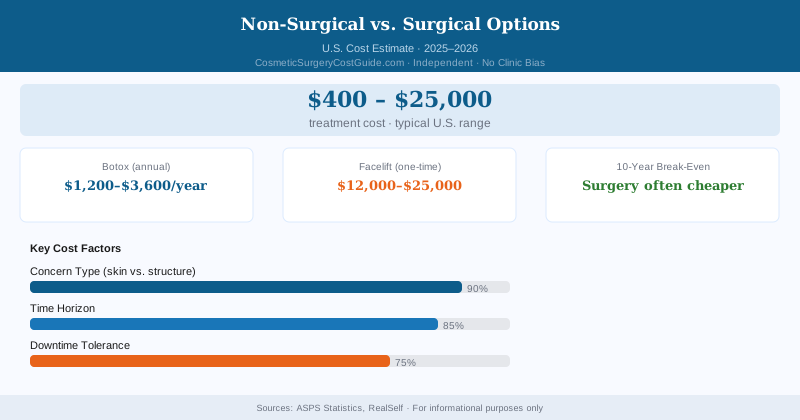
Ask a dermatologist and a plastic surgeon the same question — “should I do something about my jowls?” — and you might get two different answers. Not because one of them is wrong. Because genuinely different tools address the same concern from different angles, with different permanence, different downtime, and very different cost profiles.
The decision between non-surgical and surgical isn’t always a budget decision. It’s about understanding what each approach can actually accomplish — and where it hits a wall.
What Non-Surgical Treatments Do Well
Preventing early aging: Botox and neurotoxins don’t reverse established wrinkles — they prevent the muscle movement that creates them. Starting in your late 20s to mid-30s, before lines are etched in at rest, is when neurotoxins deliver the most preventive value. A 28-year-old who starts Botox in her forehead may never develop the deep horizontal lines that a 45-year-old is now trying to address. According to ASAPS, neurotoxin injections remain the most performed cosmetic procedure in the US each year, with over 9 million treatments annually — and a significant portion of those are preventive.
Replacing lost volume: Facial aging is largely a volume loss story. Cheek hollowing, deepened nasolabial folds, and under-eye shadows often come from the loss of fat compartments, not from skin laxity. Hyaluronic acid fillers address this directly — adding volume where it’s been lost. In the mid-face especially, fillers can achieve results that look almost surgical at a fraction of the cost and zero downtime.
Improving skin quality: Fractional lasers, chemical peels, and microneedling address texture, pigmentation, and fine lines in ways that surgery doesn’t touch. A facelift tightens and lifts; it doesn’t treat acne scarring or sun damage. These are categorically different tools working on different problems.
Body contouring without surgery: Coolsculpting (cryolipolysis) and Emsculpt (electromagnetic muscle stimulation) address mild fat and muscle definition concerns without incisions or recovery. The results are modest compared to liposuction — but for patients who want minor refinement with zero downtime, they’re appropriate.
What Only Surgery Can Accomplish
Removing excess skin: No injectable or energy device removes tissue. Once skin is stretched — from significant weight loss, pregnancy, or the natural descent of aging — only surgery excises it. A tummy tuck, facelift, arm lift, or body lift addresses tissue excess that genuinely cannot be tightened by non-surgical means. No amount of Sculptra or Ultherapy will lift skin that’s already descended past a certain threshold.
Structural correction: A rhinoplasty corrects bone, cartilage, and soft tissue structure. A blepharoplasty removes overhanging upper eyelid skin that fillers can actually worsen by adding volume to an already full area. Some structural changes require direct surgical intervention — there’s no workaround.
Meaningful volume reduction: Breast reduction, liposuction of large volume areas, and body lifts address concerns at a scale that non-surgical options can’t approach. Coolsculpting reduces fat by approximately 20–25% in a treated area — meaningful for refinement, not for significant volume reduction.
Long-term permanence: Botox lasts 3–4 months. Fillers last 6–18 months. A facelift, tummy tuck, or rhinoplasty lasts years to decades. This changes the cost calculus significantly over time.
The Maintenance Math
This is where the comparison gets genuinely surprising.
| Concern | Non-Surgical Option | Annual Cost | 10-Year Cost | Surgical Option | One-Time Cost |
|---|---|---|---|---|---|
| Forehead lines | Botox (3x/year) | $1,200 | $12,000 | Brow lift (surgical) | $5,000–$9,000 |
| Nasolabial folds | Filler (1–2 syringes/year) | $1,200–$2,400 | $12,000–$24,000 | Facelift (addresses) | $12,000–$25,000 |
| Mid-face volume | Cheek filler (annual) | $1,400–$2,800 | $14,000–$28,000 | Mid-face lift | $8,000–$18,000 |
| Abdominal fullness | Coolsculpting (2–4 sessions) | $2,000–$4,000 initial + maintenance | $10,000+ | Liposuction (abdomen) | $4,000–$8,000 |
| Skin texture | Laser/peel series | $3,000–$6,000 initial | $15,000–$25,000 | Not addressable surgically | N/A |
The maintenance math often surprises people. Consistent non-surgical treatment over a decade can cost as much as — or more than — a surgical procedure that lasts much longer. This doesn’t make surgery automatically better, but it makes the comparison more honest than “surgery is expensive.”
By Facial Zone: What Works Where
The face has different needs at different zones, and the right approach varies by location.
Forehead and brow: Botox is extraordinarily effective for horizontal forehead lines and the 11s (glabellar lines between brows). A brow lift is warranted when brow ptosis (drooping) creates heaviness over the eyes — something Botox can slightly address but not correct structurally.
Eyes and upper eyelids: Fillers do NOT belong in the upper eyelid. Over-volume in this area creates heaviness, not improvement. For true hooding — overhanging upper eyelid skin — blepharoplasty is the correct tool. For under-eye hollows (tear trough), filler is highly effective and surgery often isn’t the right answer.
Mid-face and cheeks: This is filler territory through your 30s and 40s, and often into the 50s. Well-placed cheek filler restores youthful projection and creates a significant improvement with no downtime. Surgery (mid-face lift) becomes more appropriate when skin laxity is the primary concern over volume loss.
Jowls and lower face: By the late 40s and 50s, jowling is primarily a skin laxity issue. Fillers can modestly camouflage jowl borders; they can’t lift descended tissue. After 50, a lower facelift or mini-facelift often produces results that no amount of filler can replicate.
The Combination Approach
The most sophisticated aesthetic medicine now uses surgery and non-surgical treatments together — surgery for structural correction and skin removal, non-surgical for ongoing maintenance, volume, and skin quality. A patient who has a facelift and then maintains with Botox, occasional filler, and annual laser treatments typically looks better over a decade than a patient who had surgery alone.
Non-surgical treatments extend and enhance surgical results:
- Botox after facelift maintains brow position and prevents forehead line re-etching
- Fillers after facelift restore volume that surgery doesn’t address (cheeks, lips)
- Annual laser or peel after facelift addresses skin texture and pigmentation that surgery doesn’t treat
- SPF and skincare daily — the most cost-effective anti-aging intervention that exists
Most plastic surgeons now recommend a combined maintenance plan as part of the post-surgical discussion. The patients who look the best 10 years out tend to be the ones who treated both.
The non-surgical vs. surgical decision isn’t binary — and it rarely has a clean answer. It’s a question of timing, goals, and understanding the actual limits of each approach. The most useful consultation includes an honest conversation about what’s driving your concern, what each tool can realistically accomplish, and what combination makes sense for where you are right now.