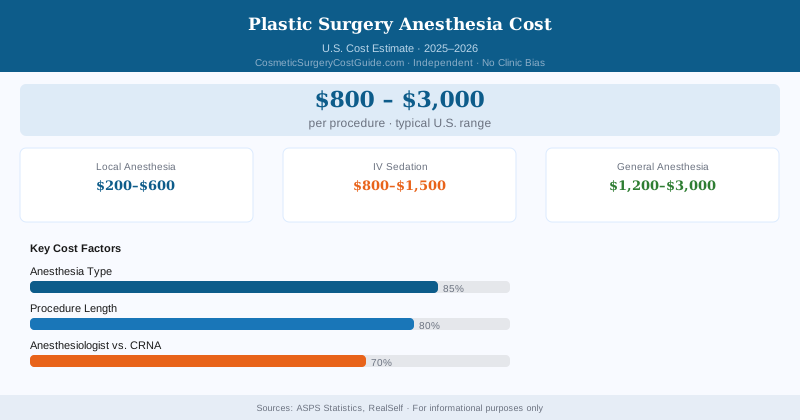
Why is anesthesia such a big separate charge? That’s one of the most common questions patients have when they see their surgical quote for the first time. You budgeted for the surgeon’s fee, and then there’s another $1,000–$2,000 line item you didn’t fully anticipate.
Anesthesia is typically the second-largest cost component in any cosmetic surgery — after the surgeon’s fee. What you pay depends on the type of anesthesia used, how long your procedure runs, and who administers it. Here’s a plain-English breakdown of how the billing works and what actually drives the price.
Anesthesia Cost by Type
| Anesthesia Type | Typical Cost | Common Procedures |
|---|---|---|
| Local anesthesia only (topical/injection) | $0–$200 | Minor procedures, skin treatments |
| Local + oral sedation | $200–$400 | Minor surgical procedures |
| IV sedation (conscious sedation/twilight) | $800–$1,500 | Breast aug, rhinoplasty, blepharoplasty |
| General anesthesia (short procedure, <2 hrs) | $900–$1,600 | Most cosmetic surgeries |
| General anesthesia (2–4 hours) | $1,200–$2,200 | Tummy tuck, facelift |
| General anesthesia (4+ hours) | $1,800–$3,500 | Combined procedures, body lift |
How is anesthesia actually billed?
Two ways, and the distinction matters.
Time-based billing: Many anesthesiologists charge per billing unit, where one unit typically represents 15 minutes. A 90-minute procedure at 6 units × $100/unit = $600 in time charges, plus a base fee. If your surgery runs longer than expected, those extra units add up.
Flat fee: Some outpatient surgery centers quote a fixed anesthesia fee for the procedure type regardless of how long it takes. More predictable, and the number you see in your quote is the number you pay.
Before you sign anything, ask which billing method applies to your case and what happens if the procedure runs over time.
Does it matter who provides my anesthesia?
Yes — both for quality and for cost.
Physician anesthesiologist (MD/DO): Highest level of training. Typically the most expensive option and required for complex cases or certain facility types.
Certified Registered Nurse Anesthetist (CRNA): Advanced practice nurses with specialized anesthesia training. They can provide care independently in most states or under physician supervision. Often 15–25% less expensive than a physician anesthesiologist.
Anesthesiologist Assistant (AA): Works under physician anesthesiologist supervision. Common in some markets, less so in others.
Surgeon-administered local or sedation: For minor procedures, some surgeons handle this themselves. No separate anesthesia fee.
What about in-network vs. out-of-network?
This mostly affects patients having partially insured procedures — rhinoplasty with a documented functional component, for example. Here’s the trap: your surgeon can be in-network while the anesthesiologist isn’t. The No Surprises Act was designed to address exactly this problem, but it’s still a situation worth preventing by asking upfront.
If any part of your procedure involves insurance billing, get the anesthesiologist’s network status confirmed in writing before your surgery date.
Choose procedures done under local/IV sedation instead of general: Many procedures (rhinoplasty, blepharoplasty, some facelifts) can be safely performed under IV sedation rather than general anesthesia. Ask your surgeon whether general anesthesia is truly required or if IV sedation is an option.
Combine procedures: Performing multiple procedures in one session means paying for anesthesia once. Adding flanks liposuction to a tummy tuck adds 30–45 minutes of OR time but not the full cost of a separate anesthesia fee.
Outpatient facility: Surgery center anesthesia fees are typically 20–30% lower than hospital-based anesthesia fees.
Ask what’s included: Some all-in quotes include anesthesia; others don’t. Make sure you’re comparing apples to apples.
What’s the actual difference between local, IV sedation, and general?
Local anesthesia only: You’re fully awake; the area being treated is numbed. Used for very minor procedures. The cost is essentially zero beyond what’s already in the surgeon’s fee.
IV sedation (twilight anesthesia): Medication goes in through an IV and puts you in a relaxed, drowsy state. You’re technically conscious but very relaxed, and you won’t remember the procedure. You’re breathing on your own the whole time. An anesthesia provider has to be present throughout.
General anesthesia: Complete unconsciousness. A machine controls your breathing. Required for long or complex procedures, or for patients who prefer it. Higher cost, slightly higher overall risk profile, and a longer recovery from the anesthesia effects themselves.
For the right procedures, IV sedation is just as safe as general anesthesia, produces less post-operative nausea, and allows faster recovery — plus it typically costs $200–$500 less. It’s worth asking your surgeon directly whether your procedure can be done under IV sedation rather than general.
Never agree to surgery under general anesthesia at a facility that cannot manage anesthesia emergencies. Any surgical setting using general anesthesia must have appropriate emergency equipment (crash cart, intubation equipment, reversal agents, defibrillator) and staff trained to manage complications. When evaluating surgical facilities, confirm AAAHC or AAASF accreditation — these organizations require specific emergency preparedness standards.
Are there anesthesia costs that come after surgery?
A few, yes.
- PACU (Post-Anesthesia Care Unit): Recovery room monitoring after general anesthesia is typically folded into the facility fee, not billed separately.
- Anti-nausea medications: Standard after general anesthesia. Usually included in the prescription bundle your surgeon provides.
- Overnight observation: For extended procedures, some patients stay overnight. That runs $500–$2,000 beyond the standard surgical center fee, billed separately.
Bottom Line
For a typical cosmetic surgery running 1.5–3 hours under IV sedation or general anesthesia, budget $900–$1,800 for anesthesia. Longer procedures push that to $1,500–$2,500. Combining procedures in one session saves money since you pay for anesthesia once instead of twice. When you’re comparing quotes, always confirm whether anesthesia is included or listed separately — that single detail can turn a $5,000 quote into a $6,500 bill.