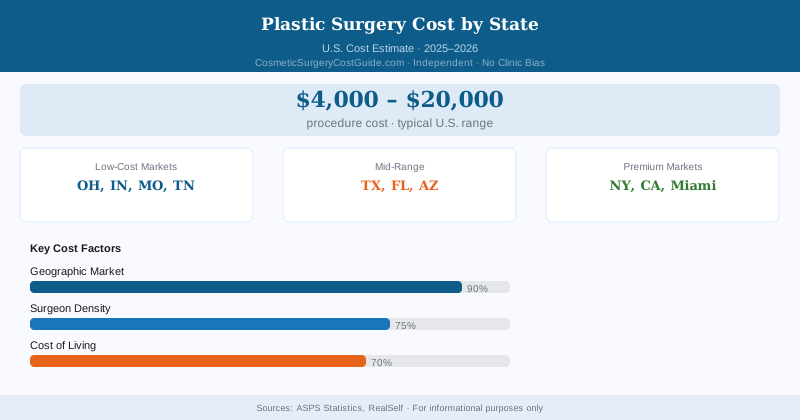
The American Society of Plastic Surgeons (ASPS) puts the national average surgeon fee for rhinoplasty at $5,483. In New York City, the same procedure with an equally board-certified surgeon routinely costs $10,000–$15,000 in surgeon fee alone. In Indianapolis or Columbus, that same credentialed surgeon charges $5,500–$7,500. That’s a 40–60% gap — and it has nothing to do with quality. It’s the cost of Manhattan rent, Manhattan staff salaries, and Manhattan market expectations passing through to the price on your quote.
Knowing this is information you can actually use — if you know how to use it.
The Four Drivers of Geographic Price Variation
1. Real estate and overhead: A surgeon’s Manhattan office space costs 4–6x what comparable space costs in Nashville or Kansas City. That overhead hits the pricing directly.
2. Local labor costs: Surgical staff, nurses, and administrators command higher salaries in high cost-of-living markets. A surgical coordinator in Beverly Hills earns meaningfully more than the same role in Louisville. That’s baked into your quote.
3. Market positioning and brand premium: Surgeons in New York and Miami compete partly on prestige. Their pricing reflects what affluent patients in those markets expect to pay — some of that reflects genuine reputation, some is simply geographic expectation.
4. Competition and volume dynamics: Markets with many board-certified surgeons competing for the same pool of patients tend to moderate prices. Markets where top surgeons are scarce allow higher pricing because patients have fewer alternatives.
State-by-State Cost Landscape
| Market Tier | States/Cities | Typical All-In Price Premium |
|---|---|---|
| Highest cost | New York City, Los Angeles, Miami, San Francisco | 40–70% above national average |
| High cost | Boston, Chicago, Seattle, Washington DC, Houston | 15–30% above average |
| Moderate cost | Dallas, Atlanta, Phoenix, Denver, Nashville | At or near national average |
| Lower cost | Midwest cities (Columbus, Indianapolis, Kansas City) | 15–25% below average |
| Lowest cost | Smaller Southern and Midwest cities | 25–40% below average |
Procedure-Specific Geographic Spread
Rhinoplasty: $5,500–$7,500 in the Midwest and South vs. $10,000–$15,000 in New York or LA. Same board certification. Same surgical training programs. Different market.
Facelift: $9,000–$13,000 all-in at a mid-market practice vs. $18,000–$30,000 at the top of coastal markets. That wide top-end range reflects both geographic premium and surgeon reputation. The two factors stack.
Breast augmentation: $6,000–$9,000 in a moderate market vs. $10,000–$14,000 in a high-cost market. Smaller absolute gap than more complex procedures, but you’re still looking at $3,000–$5,000 more for the same implant placed with the same technique.
Liposuction (single area): $3,500–$5,000 mid-market vs. $6,500–$9,000 coastal. Two areas treated in a mid-sized city can cost less than one area in New York City.
Geographic savings are only real if the surgeon’s qualifications are equivalent. Before considering travel for surgery:
- Verify ABPS board certification at abplsurg.org — both your local surgeon and the out-of-market surgeon should be ABPS certified
- Check fellowship training: ASPS member + fellowship-trained is a consistent quality marker regardless of location
- Review before/after portfolios specifically for your procedure — results quality varies by surgeon, not market
- Check Healthgrades, RealSelf, and Google reviews looking for pattern of outcomes, not isolated experiences
- Plan for two visits: initial consultation and follow-up — factor these travel costs into the total
A board-certified ABPS surgeon in Columbus with 15 years of rhinoplasty experience and a strong portfolio is not a lower-quality option than a board-certified ABPS surgeon in New York City charging twice as much.
The True Math of Traveling for Surgery
For procedures over $8,000, the geographic savings frequently justify travel. Here’s what the actual math looks like:
Facelift in Nashville vs. New York City:
- Nashville all-in (surgeon + facility + anesthesia): $11,000
- New York all-in: $19,000
- Travel costs (two trips — consultation and surgery, flights, hotel): $1,500–$2,500
- Net savings after travel: $5,500–$6,500
That’s spending $2,500 to save $8,000. The logic is pretty clear.
The calculation flips for smaller procedures: Flying across the country for a $1,500 injectable makes no sense. The travel costs equal or exceed the savings. Geographic arbitrage works best for surgical procedures with substantial fees — that’s where the spread is large enough to justify the logistics.
Markets Worth Knowing About
Nashville, Tennessee: A growing plastic surgery market with ABPS-certified surgeons priced 25–35% below coastal rates. Vanderbilt and other strong training programs have produced a deep pool of experienced surgeons here.
Columbus, Indianapolis, Kansas City: Mid-sized Midwest cities with strong academic medical centers. Well-trained ABPS surgeons at 30–40% below coastal pricing. Less glamorous than Miami, more predictable in terms of value.
Dallas, Austin, Houston: A competitive Texas market with high cosmetic surgery demand. Prices come in below New York and LA but above the Midwest. Good selection of high-volume, experienced surgeons.
Miami: Despite its reputation as a cosmetic surgery destination, Miami is actually a high-cost market. It also has an unusually high concentration of less-credentialed providers specifically targeting value-seeking patients. Verification matters more in Miami, not less. Don’t assume the market’s reputation for volume translates to value.
What Geographic Variation Doesn’t Explain
Here’s something worth knowing: the price spread within any single market can be as large as the spread between markets. In Dallas, one ABPS-certified surgeon charges $7,000 all-in for a facelift while another charges $16,000. That reflects reputation, surgical volume, and individual demand — not geography.
Within any market, you can find better pricing by:
- Consulting with newer ABPS surgeons building their practices (often 20–30% below established peers for the same credentials)
- Looking at suburban practices vs. city-center practices
- Scheduling consultations during slower booking periods
Several states with high cosmetic surgery volumes — notably Florida, California, and Texas — have also documented higher rates of cosmetic surgery complaints and disciplinary actions. High volume markets attract both excellent providers and problematic ones. State variation in cost should never be confused with state variation in quality. Credentialing verification matters in every market.
Bottom Line
A 30–40% price difference between equivalent ABPS surgeons in different markets is real, and it’s exploitable when the procedure fee is large enough that travel costs don’t eat the savings. The most reliable approach: get your local quote first as a reference, then get one quote from a comparable surgeon in a moderate-cost market. The comparison will tell you whether the travel makes sense. Never trade credential quality for savings — that’s the one trade-off that doesn’t work out. Trade geographic premium for geographic value.