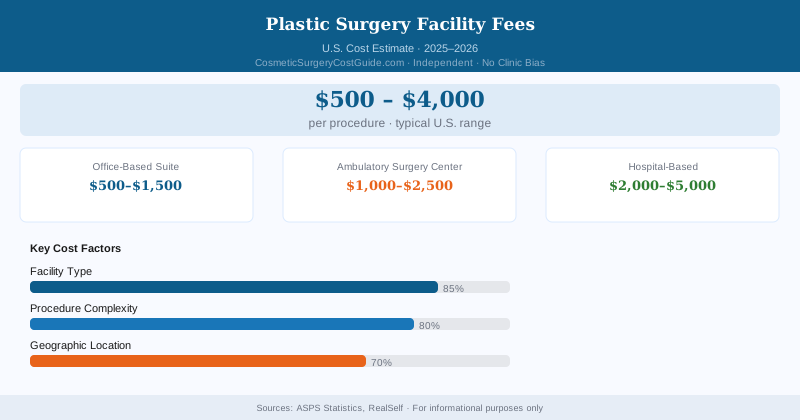
When you’re reviewing a cosmetic surgery quote, you’ll notice three separate cost buckets: surgeon’s fee, anesthesia, and facility fee. Most patients focus on the first two. The facility fee is the one that catches people off guard — it can range from $800 to $4,500 for the same procedure, depending entirely on where it’s performed.
A hospital operating room can cost 50–100% more than an accredited ambulatory surgery center. That’s not a small number. For a $12,000 procedure, the facility choice alone can swing your total by $1,500–$2,500. Here’s a clear-eyed look at what drives that difference and how to think about it.
Facility Fee by Setting
| Facility Type | Typical Fee Range | Notes |
|---|---|---|
| Surgeon’s office-based suite | $500–$1,500 | Appropriate for minor procedures |
| Accredited ambulatory surgery center | $800–$2,500 | Most common for cosmetic surgery |
| Hospital outpatient surgery | $1,500–$4,500 | Higher overhead; required for some cases |
| Hospital inpatient (overnight stay) | $3,000–$8,000+ | Major procedures, complex cases |
Why Hospitals Cost More
Hospitals carry overhead that ambulatory surgery centers simply don’t have:
- 24/7 emergency capability, ICU, and full support services
- Higher-paid staff (union wages in many markets)
- More administrative and regulatory overhead
- Higher supply costs through hospital purchasing channels
All of that cost hits your facility fee — even for elective procedures that use none of that infrastructure. You’re paying for the hospital’s entire ecosystem, not just the operating room you’ll actually be in.
For healthy patients having straightforward cosmetic procedures, that premium doesn’t translate into meaningfully better care. An accredited ambulatory surgery center provides equivalent safety at lower cost.
What “Accredited” Means — And Why It’s Non-Negotiable
Not all surgical suites are created equal. Three major accreditation bodies evaluate ambulatory surgery centers:
AAAHC (Accreditation Association for Ambulatory Health Care): The most common accreditor for cosmetic surgery centers
AAASF (American Association for Accreditation of Ambulatory Surgery Facilities): Specifically focused on aesthetic surgery
Joint Commission: The same body that accredits hospitals; also accredits ambulatory surgical centers
To earn any of these accreditations, a facility must demonstrate:
- Qualified anesthesia providers
- Emergency equipment on site (crash cart, defibrillator, intubation supplies)
- Proper sterilization protocols
- Staff credentialing review
- Patient safety protocols
- Quality improvement processes
That’s the floor. An accredited ambulatory surgery center offers essentially equivalent procedural safety to a hospital OR for the procedures routinely performed in cosmetic surgery — at substantially lower cost.
Before agreeing to surgery at any facility, ask:
- Is this facility AAAHC, AAASF, or Joint Commission accredited?
- Can I see the accreditation certificate?
- What emergency equipment is available if something goes wrong?
- What hospital does this facility have a transfer agreement with?
- Will my anesthesiologist be present throughout the procedure or leave for other cases?
A legitimate, professional surgical facility will answer these questions without hesitation. Hesitation or inability to answer is a red flag.
Office-Based Surgery: When It Makes Sense
Many board-certified plastic surgeons run their own accredited office-based surgical suites. For the right cases — minor procedures, local anesthesia, short duration — that’s a safe and cost-effective option.
For more extensive procedures under general anesthesia (tummy tuck, facelift, combined mommy makeover), you want a freestanding accredited ambulatory surgery center or hospital, not an office suite — even an accredited one. The staffing levels and emergency response capability are simply stronger.
When You Actually Need a Hospital
Some situations genuinely call for a hospital setting. These aren’t preferences — they’re clinical requirements:
- Complex medical comorbidities: significant cardiac or pulmonary conditions, severe obesity
- Procedures requiring overnight monitoring: major body lifts, complex reconstructions
- Patient history that requires close emergency access
- High BMI above the surgeon’s outpatient threshold (typically 35+)
- Surgeon lacks privileges at any accredited outpatient facility
Your surgeon should walk you through facility choice in the context of your specific health history. If they’re recommending a hospital setting without explanation, ask why. If they’re recommending an outpatient setting for a case that seems complex, that’s also worth pressing on.
What’s Included in the Facility Fee
Standard facility fees cover:
- Operating room use and setup
- Nursing staff during the procedure
- Sterile supplies and equipment
- Recovery room monitoring
- Standard medications used during and immediately after surgery
What’s often not included — and what generates separate line items:
- Implant cost (breast implants, chin implants are typically listed separately)
- Specialty equipment some surgeons charge for individually
- Extended recovery room time beyond the standard window
- Overnight stay (always charged separately)
Always request an itemized breakdown before you sign your surgical agreement. “All-in” means different things at different practices.
The lowest facility fee is not the best goal. Surgical facilities that are not accredited by AAAHC, AAASF, or Joint Commission cut costs by also cutting safety infrastructure. Fatalities from cosmetic procedures have disproportionately occurred in non-accredited settings. Accreditation is not optional — it’s the minimum standard. Saving $500 on a facility fee at a non-accredited location is a poor trade-off against the reduced safety that comes with it.
Geographic Variation in Facility Fees
Facility fees track local costs the same way surgeon fees do:
- Major metros (New York, Los Angeles, Miami): $1,500–$3,500+ at accredited ASCs
- Mid-sized markets (Atlanta, Phoenix, Dallas): $800–$2,000
- Smaller markets: $700–$1,500
Hospital-based surgery in any market runs 50–80% above ASC rates for the same procedure. That premium exists regardless of geography.
Cost Impact of Facility Choice
On a $12,000 all-in rhinoplasty, here’s what the facility decision actually does to your total:
- Equivalent procedure at accredited ASC: $10,500–$11,500
- Same procedure at hospital outpatient: $12,000–$14,000
- Difference driven entirely by facility: $1,500–$2,500
If you don’t have a medical reason to require a hospital setting, asking your surgeon whether an accredited ASC is available and appropriate is a straightforward conversation worth having.
Bottom Line
Budget $800–$2,500 for accredited ambulatory surgery center facility fees on most cosmetic procedures. Hospital-based fees run $1,500–$4,500 or more. Verify accreditation before you agree to anything — AAAHC, AAASF, or Joint Commission. For healthy patients having standard cosmetic procedures, an accredited ASC provides equivalent safety to a hospital OR at meaningfully lower cost. That’s not a compromise. That’s just where the right value is.