Two patients. Same procedure. Same city. One pays $9,000 for a breast augmentation at a private practice. The other pays $4,500 at an academic medical center’s resident training clinic — and has an attending board-certified plastic surgeon present and supervising throughout.
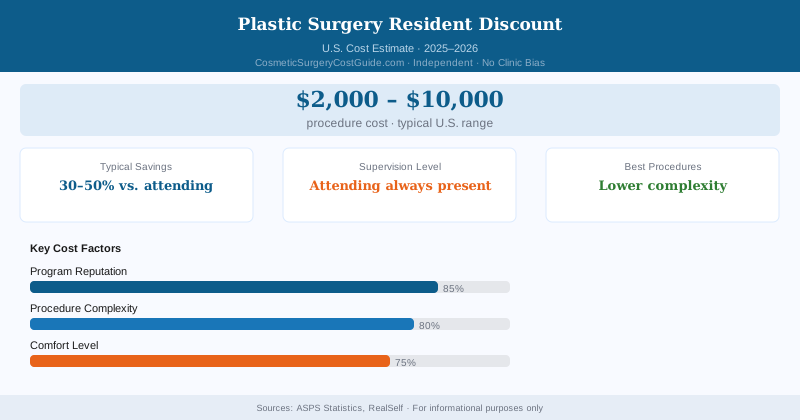
That’s not a hypothetical. Academic plastic surgery programs at major medical centers across the US offer cosmetic procedures to the public at 30–50% below private practice rates. Most patients have never heard of this option because these programs don’t advertise heavily and they don’t show up easily in a Google search for “plastic surgeon near me.”
Here’s what you get, what you give up, and how to decide whether it makes sense for your situation.
What a Resident Training Program Actually Is
Plastic surgery residents are physicians — MDs or DOs — who have completed medical school and are in the middle of a 6-year (integrated) or 3-year (following a general surgery residency) specialized training program in plastic surgery. By the time they’re performing cosmetic procedures in a training clinic:
- A third-year resident has 2–4 years of surgical training and has assisted in or led hundreds of procedures under supervision
- A fifth-year resident has performed this procedure many times under varying levels of supervision
- An attending surgeon — fully trained, board-certified — is present and supervising throughout
The attending doesn’t leave the room. In most programs, they’re scrubbed in and directly involved. The structure varies by program and by procedure complexity, but patients are not left with an unsupervised trainee. That’s a critical point. The American Council on Graduate Medical Education (ACGME), which accredits these programs, requires meaningful attending oversight.
| Procedure Type | Private Practice Rate | Resident Program Rate | Typical Savings |
|---|---|---|---|
| Rhinoplasty | $8,000–$14,000 | $3,500–$6,000 | 40–55% |
| Breast augmentation | $6,500–$11,000 | $3,500–$5,500 | 35–50% |
| Blepharoplasty (upper) | $3,000–$6,000 | $1,500–$2,800 | 40–50% |
| Facelift | $12,000–$20,000 | $5,500–$9,000 | 40–55% |
| Tummy tuck | $9,000–$16,000 | $4,500–$7,500 | 40–50% |
| Liposuction (1 area) | $3,500–$7,000 | $1,800–$3,500 | 40–50% |
| Ear pinning (otoplasty) | $4,000–$7,000 | $2,000–$3,500 | 40–50% |
The Real Trade-Offs
This is where honesty matters. Here’s what you’re actually giving up:
Longer time under anesthesia: Residents work more methodically and more slowly than a surgeon with 15 years of private practice. A procedure that takes an attending 2 hours might take a resident team 3–4 hours. That has downstream effects:
- You’re under anesthesia longer (which isn’t trivial)
- Anesthesia fees are often time-based, so longer OR time means a higher anesthesia bill
- Your recovery period in the facility extends
Less accumulated aesthetic judgment: Residents learn to perform the procedure correctly. What they haven’t yet built is the aesthetic intuition — the eye for proportion, symmetry, and subtle refinement that comes from doing 500 of these over a career. A technical outcome can be excellent while the aesthetic result is competent but lacks the fine-tuning an experienced surgeon would add. That distinction matters a lot for rhinoplasty and facelifts. It matters less for procedures where the primary goal is technical correctness (functional blepharoplasty, otoplasty).
Less control over who specifically operates on you: In private practice, you choose your surgeon, meet them multiple times, build a relationship. In a resident clinic, you may meet your resident at or just before the procedure. For patients who place significant value on that relationship, it’s a real trade-off.
Scheduling constraints: Resident clinics run around training schedules, attending availability, and OR access. You’ll have less flexibility in timing than you’d have at a private practice.
Academic medical centers with plastic surgery residency programs accept patients for their resident clinics. Most major cities have at least one:
- Search “[your city] + academic medical center + plastic surgery” to identify hospital systems with training programs
- Call the plastic surgery department directly and ask: “Do you have a resident training clinic for cosmetic procedures, and do you accept self-pay patients?”
- Major programs with well-known resident clinics include university hospital systems at large public universities — state medical schools typically have these programs
- The ACGME (Accreditation Council for Graduate Medical Education) accredits plastic surgery residency programs — their website lists all accredited programs by institution, which you can search to find programs near you
Wait times for resident clinic appointments are often longer than private practice — plan for 2–4 weeks minimum for an initial consultation.
Which Procedures Work Best in a Resident Setting
Good fits for resident programs:
- Breast augmentation — technically well-defined with clear objectives, attendings very involved
- Otoplasty (ear pinning) — excellent results in a resident setting; a great procedure for skill development
- Functional blepharoplasty — upper eyelid for vision obstruction; functional goal with a clear endpoint
- Tummy tuck — technically complex, which means attendings are typically highly involved throughout
- Liposuction of straightforward areas
Proceed with more care:
- Primary rhinoplasty — appropriate in a resident setting, but make sure you’re comfortable with the trade-off in aesthetic refinement
- Complex revision rhinoplasty — typically not appropriate; better suited to a highly experienced revision specialist
- Facelift — the aesthetic complexity and subtlety involved argue for heavy attending involvement; ask explicitly about the attending’s role before proceeding
- Any highly customized procedure where the result depends substantially on in-surgery judgment calls and aesthetic adjustment
The Money Math
Breast augmentation at $4,500 (resident program) vs. $9,000 (private practice): savings of $4,500. If the resident program’s time-based anesthesia runs $600 higher due to longer OR time, net savings come to $3,900. That’s a meaningful amount.
On a facelift, the savings can reach $7,000–$11,000. For a patient who’s genuinely comfortable with the training program model and the trade-offs it involves, those numbers represent a real financial difference.
Resident training programs are not appropriate for patients who are high surgical risk (significant cardiovascular disease, obesity, bleeding disorders) or for procedures with extremely narrow technical margins. The attending surgeon will assess your candidacy — be fully honest about your medical history. An attending who declines to perform your procedure in a resident setting is giving you important guidance, not a rejection. Listen to it.
Questions to Ask at Your Resident Program Consultation
Don’t skip these:
- “What is the attending surgeon’s specific role during my procedure — are they scrubbed in or supervising from outside?”
- “Who specifically will be leading the surgery, which year resident are they, and how many times have they performed this procedure?”
- “How many times has an attending at your program performed this specific procedure?”
- “What happens if a complication occurs during surgery?”
- “Who do I contact post-operatively, and will I see the same team at follow-up visits?”
A program that answers these questions directly and confidently is comfortable with transparency. One that deflects, hedges, or gets vague about attending involvement deserves more scrutiny before you commit.
Bottom Line
Academic plastic surgery resident programs offer 30–50% savings on cosmetic procedures with board-certified attending surgeons present and supervising throughout. The trade-off is longer OR time, less accumulated aesthetic refinement from the resident specifically, and a less personal surgical relationship. For technically well-defined procedures where a correct result is the main goal — breast augmentation, otoplasty, functional blepharoplasty — the savings are real and the trade-offs are manageable. For highly aesthetic procedures where the result depends heavily on experienced judgment calls — rhinoplasty, facelift — your comfort with that trade-off matters more, and deserves careful thought.