In 2013, Kim Kardashian posted a photo of herself mid-treatment — face covered in blood, needles everywhere — and the internet reacted with a mixture of horror and fascination. The “Vampire Facial” became one of the most searched aesthetic treatments practically overnight.
More than a decade later, PRP (platelet-rich plasma) facials are still a steady fixture in medical aesthetics. Not because of the shock value — that wore off fast — but because enough patients reported genuine results that the treatment found a legitimate audience. The procedure works by drawing your own blood, processing it to concentrate the growth factors, then applying or injecting that concentrate to stimulate collagen production and skin renewal.
Does it work? Moderately, for the right candidates. Is it worth what it costs? That depends on what you’re actually trying to fix.
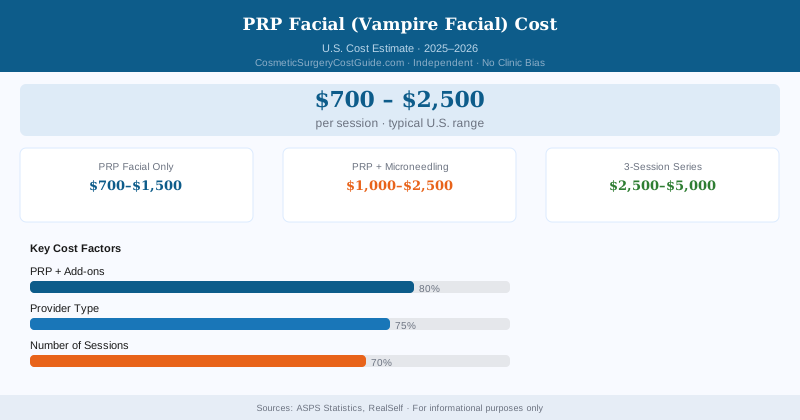
PRP Facial Cost in 2025
| Treatment Type | Cost Per Session | Sessions Recommended | Total Course Cost |
|---|---|---|---|
| Topical PRP (microneedling + PRP) | $400–$900 | 3–4 | $1,200–$3,600 |
| PRP injections only (intradermal) | $600–$1,200 | 3 | $1,800–$3,600 |
| PRP + microneedling (RF) | $800–$1,500 | 3 | $2,400–$4,500 |
| PRP under-eye treatment | $400–$800 | 2–3 | $800–$2,400 |
| PRP for hair restoration | $700–$1,500 | 3–6 | $2,100–$9,000 |
What PRP Actually Is
Your blood contains plasma — the liquid portion — loaded with platelets. Platelets carry growth factors that help healing and tissue regeneration. PRP is made by:
- Drawing 20–60mL of your blood
- Centrifuging it to separate plasma from red blood cells
- Concentrating the platelet-rich portion
- Applying or injecting that concentrate to the treatment area
The growth factors in PRP — including PDGF, TGF-β, and VEGF — stimulate fibroblasts to produce collagen and promote tissue regeneration. That’s the biology that gave this treatment staying power well beyond the Instagram moment.
How PRP Is Applied: Topical vs. Injected
Microneedling + topical PRP: The most common approach. Microneedling creates thousands of tiny channels in the skin. PRP gets applied topically immediately after — those channels let it penetrate deeply rather than sitting on the surface. You’re getting collagen stimulation from both the microneedling trauma and the growth factors. This is what went viral.
Injected PRP (mesotherapy-style): PRP is injected directly into the dermis using a series of small injections or a microinjection device. More direct delivery to the tissue. Some providers prefer this for targeted treatment areas where they want precise placement.
Combined RF microneedling + PRP: A newer protocol pairing the collagen stimulation of RF microneedling with PRP’s biostimulation. The premium option in terms of both cost and potential results.
PRP facials work best for:
- Fine lines and skin texture improvement
- Skin tone and radiance
- Mild skin laxity
- Under-eye quality (improved skin thickness and darkness)
- Hair thinning (when injected into scalp)
PRP facials are NOT effective for:
- Deep wrinkles or folds
- Significant volume loss (this needs filler)
- Pigmentation spots (laser or chemical peel is more effective)
- Dramatic skin tightening
Expect subtle, gradual improvement — more radiance and texture refinement than dramatic structural change. Results typically require 3 sessions and become visible over 2–3 months.
PRP Facial vs. Other Skin Treatments by Cost
| Treatment | Cost Per Session | Sessions | Total | Results |
|---|---|---|---|---|
| PRP facial | $600–$1,000 | 3 | $1,800–$3,000 | Subtle to moderate |
| Microneedling (no PRP) | $250–$600 | 4 | $1,000–$2,400 | Similar to PRP |
| Chemical peel (medium) | $500–$1,200 | 1–2 | $500–$2,400 | Texture, pigment |
| Laser resurfacing (non-ablative) | $1,000–$2,500 | 3 | $3,000–$7,500 | More significant |
| Botox | $300–$600 | 3/year | $900–$1,800/yr | Different indication |
PRP competes most directly with standard microneedling in terms of what it treats and what patients expect from it. The real question is whether adding PRP to a microneedling session — at $200–$500 more per treatment — produces meaningfully better results. Research suggests yes for certain outcomes like skin texture and radiance, but don’t expect dramatic differences. Subtle is the word you’ll hear from honest providers.
Safety Considerations
PRP has a genuine safety advantage: it’s derived from your own blood, which makes allergic reaction or rejection essentially impossible. Side effects come primarily from the needling component — redness, mild swelling, sensitivity lasting 24–48 hours.
But a real safety concern surfaced in 2018: multiple patients in New Mexico contracted HIV and hepatitis C after PRP facials at a spa that reused needles and failed to follow proper blood handling protocols. Extreme malpractice — but a real incident, and it highlights something important:
PRP involves blood products and requires strict sterile technique and single-use needles throughout the entire process. Only receive PRP treatments from licensed medical providers in a clinical setting — not spas without medical oversight. The provider should use sterile, single-use blood draw equipment, centrifuge kits, and needles for each patient. Never share PRP equipment. A legitimate provider should be happy to explain their sterile protocol when asked.
PRP for Hair Loss
PRP for scalp injection is one of the more evidence-supported applications of the technology. Multiple clinical trials show real improvement in hair density and thickness for patients with androgenetic alopecia (pattern baldness). The American Academy of Dermatology (AAD) recognizes PRP scalp injection as a treatment option worth discussing for appropriate hair loss patients.
The standard protocol is 3–6 sessions every 4–6 weeks, followed by quarterly maintenance. Cost runs $700–$1,500 per session, with a full initial course at $2,100–$9,000. The clinical evidence here is stronger than for facial PRP, and hair loss patients tend to see more measurable, satisfying results.
Bottom Line
Three sessions of PRP facial with microneedling at a licensed medical practice: budget $1,800–$3,000. It’s a legitimate option for patients who want skin radiance and texture improvement without the intensity of laser or peels. It won’t do dramatic heavy lifting, but it uses your own biology, carries minimal downtime, and has a strong safety profile when performed correctly. For hair loss specifically, the evidence is stronger and the investment more clearly justified.