Your upper eyelid is drooping into your field of vision. Your ophthalmologist says your visual field is affected. That’s ptosis — and unlike most cosmetic surgery, it might actually be covered by insurance. The American Academy of Ophthalmology estimates that acquired blepharoptosis (droopy upper eyelid) affects up to 11.5% of the US population, and while mild cases are common with normal aging, severe ptosis can genuinely impair vision and quality of life.
Here’s what the surgery costs, when insurance steps in, and what separates ptosis repair from standard cosmetic blepharoplasty.
Ptosis Repair Cost by Procedure Type
| Procedure | Surgeon Fee | All-In Cost |
|---|---|---|
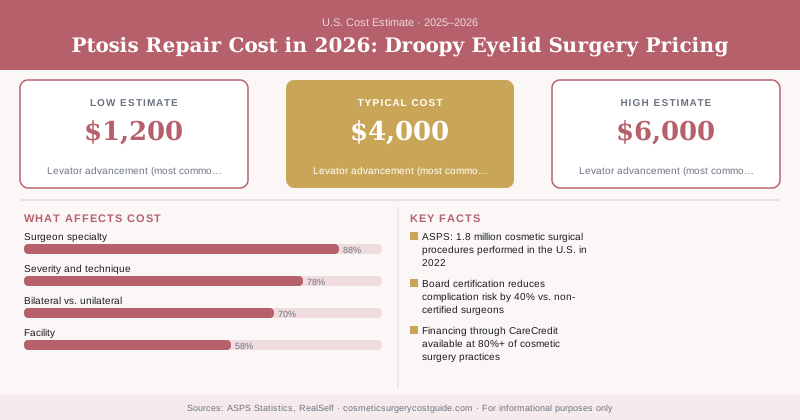
| Levator advancement (most common) | $1,200–$4,000/eye | $2,000–$6,000/eye |
| Frontalis sling (severe/neurological ptosis) | $2,500–$5,500/eye | $4,000–$8,500/eye |
| Müller’s muscle resection (mild ptosis) | $1,000–$2,500/eye | $1,800–$4,500/eye |
| Combined ptosis repair + blepharoplasty | $3,500–$8,000 | $5,500–$12,000 |
Bilateral (both eyes) procedures typically cost 1.5–1.8x the single-eye cost, not twice — because anesthesia and facility fees don’t double for the second eye.
The Insurance Question: When Ptosis Repair Is Covered
This is the key financial question. Insurance — including Medicare — covers ptosis repair when:
- Visual field testing documents that the drooping eyelid obstructs your superior visual field by a specific percentage (typically 30% or more on Humphrey visual field testing)
- Margin reflex distance (MRD) measurements show the upper eyelid covering 2mm or less of the corneal light reflex
- The condition interferes with daily activities (driving, reading, using stairs)
If your drooping is cosmetic — you just don’t like how tired or heavy your eyes look, but there’s no documented vision impairment — insurance won’t cover it. It comes down to that visual field test.
When insurance does cover it, your out-of-pocket is typically your deductible plus coinsurance — often $500–$2,500 depending on your plan — versus $5,000–$8,000+ self-pay.
- Start with your ophthalmologist or optometrist, not a plastic surgeon. They document the medical necessity.
- Get a formal visual field test (Humphrey perimetry). Ask specifically: “Does my ptosis affect my superior visual field by 30% or more?”
- If it does, get a referral to an oculoplastic surgeon (not a general plastic surgeon — oculoplastics is the subspecialty for eyelid surgery).
- The surgeon’s office handles pre-authorization. Keep copies of all visual field test results.
- If denied, appeal with your ophthalmologist’s documentation. Many initial denials are overturned.
Ptosis Repair vs. Blepharoplasty: An Important Distinction
These are often confused but are genuinely different procedures addressing different problems.
Blepharoplasty removes excess skin and fat from the upper eyelid. It addresses hooding (extra skin folding over the lid margin) and visible fat pads. It’s almost always cosmetic.
Ptosis repair addresses the muscle or tendon responsible for lifting the upper eyelid — the levator muscle or Müller’s muscle — when it’s weak, stretched, or detached. The eyelid margin itself sits too low. Simply removing skin won’t fix it; the muscle mechanics must be corrected.
Some patients need both. When combined, the procedures are typically done in one OR session, saving on anesthesia and facility fees. Make sure your surgeon identifies which problem you actually have — blepharoplasty alone on a patient who primarily needs ptosis repair won’t produce the right result.
What Drives the Cost
Surgeon specialty: Oculoplastic surgeons (fellowship-trained specialists in eyelid, orbit, and lacrimal surgery) command higher fees than general plastic surgeons for ptosis — and are generally the right choice. Their additional training in eyelid mechanics translates to better outcomes and lower revision rates. Board certification by the American Board of Ophthalmology with completion of an oculoplastics fellowship is the credential to look for.
Severity and technique: Mild ptosis treated with Müller’s muscle resection is a shorter, less complex procedure than a frontalis sling operation for severe congenital or neurological ptosis. More complex cases cost more.
Bilateral vs. unilateral: Fixing both eyes costs more than one but not twice as much — you’re saving on the setup costs (anesthesia, OR time) for the second eye.
Facility: Office-based procedures under local anesthesia run cheaper than outpatient surgery center procedures. Most adult ptosis repairs can safely be done with local anesthesia only, keeping costs lower.
Congenital ptosis in children is always considered potentially medical — it can cause amblyopia (lazy eye) and permanently impair vision development if not corrected early. If your child has a drooping eyelid, get an ophthalmology evaluation immediately. Pediatric ptosis repair is typically covered by insurance and is time-sensitive. Don’t delay it waiting on cost questions.
Recovery Expectations
Most patients have swelling and bruising for 1–2 weeks. The eyelid height often looks slightly overcorrected immediately after surgery (the lid may sit higher than intended) — this is expected and settles over 4–8 weeks. Some temporary dryness and difficulty closing the eye completely is normal in the first few weeks.
Results are typically long-lasting. Recurrence is possible — the levator muscle can stretch again with age — but most patients get 10–20 years of good results from a well-performed repair.