Most people who ask about RF microneedling have already done standard microneedling and want more. Maybe they got decent texture improvement but their skin laxity didn’t budge. Maybe their acne scars improved some but not enough. They’re looking for the next level without going full ablative laser — the kind of treatment that means a week of looking like a sunburn victim.
RF microneedling is exactly that middle ground. It combines the collagen stimulation of standard microneedling with thermal radiofrequency energy delivered at depth — producing results that neither technology achieves on its own. For patients in their late 30s to 50s with moderate laxity, acne scars, or textural concerns, it’s become a genuinely useful tool. Morpheus8 alone had a significant presence in surveys of popular aesthetic procedures tracked by the American Society for Dermatologic Surgery (ASDS) in recent years.
RF Microneedling Cost in 2025
| Device | Area | Cost Per Session | Full Course (3 sessions) |
|---|---|---|---|
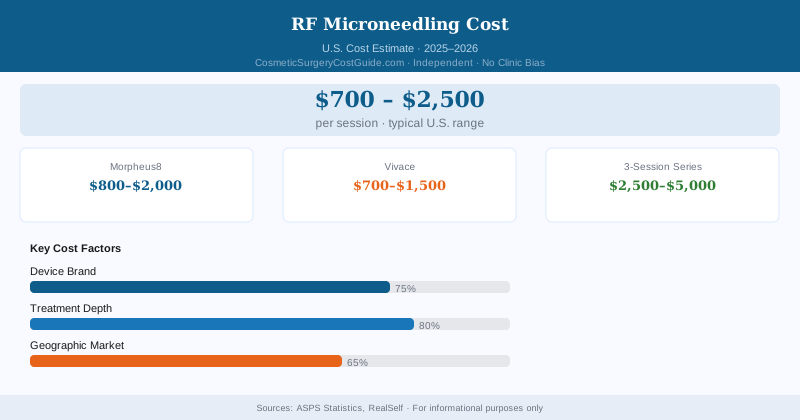
| Morpheus8 (face) | Full face | $900–$1,800 | $2,700–$5,000 |
| Morpheus8 (face + neck) | Face + neck | $1,200–$2,200 | $3,600–$6,000 |
| Morpheus8 Body | Abdomen, thighs, arms | $1,000–$2,000 | $3,000–$6,000 |
| Potenza (face) | Full face | $800–$1,600 | $2,400–$4,500 |
| Secret RF (face) | Full face | $700–$1,500 | $2,100–$4,500 |
| Vivace (face) | Full face | $700–$1,400 | $2,100–$4,200 |
Morpheus8: The Market Leader
Morpheus8 (Inmode) has become the dominant brand name in RF microneedling — it’s the Botox of its device category, recognizable enough that patients ask for it by name. It uses needles that penetrate to 4mm depth (up to 8mm in body mode), delivering RF energy at precisely controlled depths to remodel collagen and fat at the subdermal level.
What separates Morpheus8 from basic RF microneedling devices:
- Fractional energy delivery at multiple tissue depths simultaneously
- A body handpiece specifically for treating laxity on the abdomen, thighs, and arms
- Clinical data supporting remodeling of subdermal fat, not just skin surface tightening
It’s meaningfully more effective for skin laxity than standard microneedling, and it tends to be more affordable than Ultherapy or Thermage for comparable tightening in the patients who are right for it.
Standard Microneedling vs. RF Microneedling vs. Laser: Where Does It Fit?
| Treatment | Course Cost | Results for Laxity | Results for Scars | Downtime |
|---|---|---|---|---|
| Standard microneedling | $600–$2,000 | Mild | Moderate | 1 day |
| RF microneedling (Morpheus8) | $2,700–$5,000 | Moderate | Good | 3–5 days |
| Fraxel laser (non-ablative) | $3,000–$6,000 | Mild-moderate | Good | 2–4 days |
| Fraxel CO2 (ablative) | $1,500–$3,000 | Moderate-good | Very good | 7–10 days |
RF microneedling sits squarely between standard microneedling and ablative laser in terms of both cost and results. For a lot of patients, that positioning is exactly right.
Both technologies address skin laxity. The choice depends on:
RF microneedling (Morpheus8): Better for skin texture + tightening + acne scars simultaneously. Works at multiple depths. 3–5 days of social downtime per session.
Ultherapy: Better for targeted lifting of the brow and jowl via SMAS stimulation at 4.5mm. No surface disruption. More appropriate for specifically anatomical lifting goals.
For patients primarily concerned with skin quality, texture, and overall tightening: RF microneedling. For patients focused on lifting specific facial zones: Ultherapy. Many providers combine both.
What RF Microneedling Treats
Best indications:
- Mild to moderate skin laxity (face, neck, jawline)
- Acne scars — especially rolling and boxcar types
- Enlarged pores
- Skin texture and roughness
- Fine to moderate lines
- Body laxity (abdomen after weight loss, inner thighs)
- Hyperhidrosis — excessive sweating — since the RF energy can reduce sweat gland activity
Not ideal for:
- Severe skin laxity that actually needs surgery
- Deep, pitted ice pick acne scars (those need punch excision)
- Significant pigmentation issues (IPL or laser is better targeted for those)
What to Expect from the Treatment
Here’s the honest play-by-play for patients who want to know what they’re getting into:
Before: Topical numbing cream goes on 30–60 minutes before treatment. Some providers offer oral sedation or nerve blocks for patients who want more comfort. Don’t skip the numbing — this is noticeably uncomfortable without it.
During: Pressure and heat, with the RF delivery at depth creating a distinct sensation beyond just needle insertion. Most patients tolerate it fine with adequate numbing.
Right after: Redness and mild swelling for 24–48 hours. Some pinpoint bleeding at needle sites. Skin looks “textured” for 2–3 days before it smooths out. Most people return to work in 3–5 days with makeup coverage.
Results timeline: Some immediate improvement from the physical microneedling component. The full benefit from RF collagen stimulation develops gradually over 3–6 months after completing the full course. Don’t expect to walk out looking transformed.
RF microneedling devices have different settings, needle depths, and RF delivery protocols. Providers who are not properly trained can deliver too much energy (causing burns, scarring) or too little (producing no meaningful results). Morpheus8 and other RF microneedling devices require specific training for safe and effective use. When researching providers, ask how many RF microneedling treatments they perform monthly, what training they’ve had, and ask to see before-and-after photos from their own patient cases — not manufacturer stock images.
Acne Scar Treatment: How Many Sessions?
For acne scars, most providers recommend 3 sessions spaced 4–6 weeks apart. Patients with moderate scarring typically see 50–70% improvement after a full course — that’s meaningful, but it’s not erasure. Significant deep scarring often needs additional sessions or combination with other techniques like subcision or punch excision.
After the initial course, many patients do annual maintenance sessions to sustain collagen remodeling and address any new texture changes before they become established.
Bottom Line
A 3-session Morpheus8 course for facial skin tightening and texture runs $3,000–$5,000 in most markets. Potenza and Secret RF come in at $2,400–$4,500 with comparable results. For patients in their late 30s to 50s dealing with moderate laxity and texture concerns, RF microneedling is a genuinely useful middle-ground investment — you’ll get meaningfully more benefit than standard microneedling without the extended recovery of ablative laser. Choose a provider who performs this regularly, can show you their own before-and-after photos, and can tell you exactly how many of these treatments they do each month.