The American Society for Dermatologic Surgery (ASDS) reports that dermatologists performed over 540,000 scar revision procedures in a single recent year — and that number doesn’t include plastic surgeons. Scars are one of the most common reasons people seek cosmetic treatment. They’re also one of the most mismanaged, because the treatment must match the scar — and no two scars are the same.
A keloid and an acne scar require completely different approaches. The wrong treatment doesn’t just fail; it can make things worse. Getting this right starts with understanding what type of scar you’re actually dealing with.
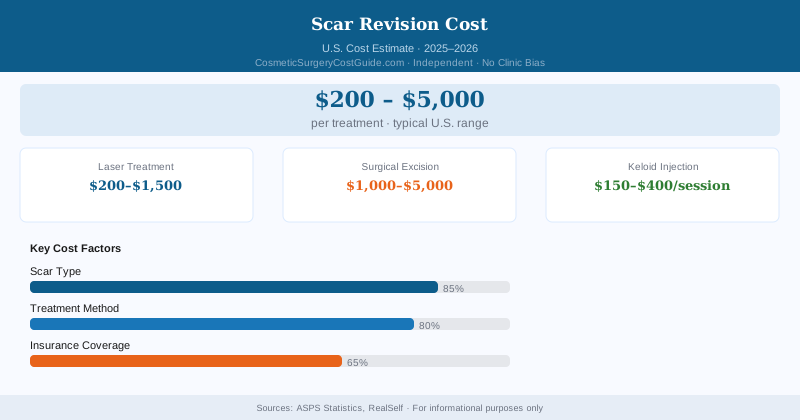
Scar Revision Cost by Method
| Treatment | Cost Range | Best Scar Types |
|---|---|---|
| Steroid injection (intralesional) | $100–$300/session | Keloid, hypertrophic |
| Silicone sheeting/gel | $30–$100/month | All scar types (prevention/early treatment) |
| Laser (non-ablative, vascular) | $300–$800/session | Red, raised, vascular scars |
| Laser resurfacing (ablative/fractional) | $500–$2,500/session | Atrophic, textured scars |
| Filler injection | $400–$800/session | Depressed/atrophic scars |
| Subcision | $300–$600/session | Rolling acne scars, depressed scars |
| Surgical excision (simple) | $500–$2,000 | Widened or poorly healed scars |
| Surgical revision (complex) | $2,000–$8,000 | Complex scars, contractures |
| Punch excision (acne scars) | $300–$700 | Ice pick acne scars |
Scar Types and Appropriate Treatments
Keloid scars: Raised, firm, and they grow beyond the original wound margins — sometimes significantly. They don’t just stop healing; they overshoot. Treatment is intralesional steroid injections (triamcinolone) every 4–6 weeks, typically 3–5 sessions. Surgical excision alone almost always causes a worse keloid to grow back. Combined steroid-plus-surgery has much better recurrence rates.
Hypertrophic scars: Raised and thick, but they stay within the wound boundaries — that’s the key distinction from keloids. They often fade on their own over 12–18 months. Steroid injections, silicone sheeting, and pulsed dye laser (Vbeam) all work well here. More forgiving than keloids.
Atrophic/depressed scars: These sit below the skin surface — most acne scars, chickenpox scars, and some surgical scars fall here. Treatment options include subcision (releasing the tethers pulling the scar down), filler for temporary volume, fractional laser resurfacing, microneedling, and punch excision for deep pitted scars.
Widened/stretched scars: Flat but wide, common after surgeries or wounds under tension. Treatment is surgical re-excision and closure with better technique — reduced tension, proper layered suturing. Often a one-time correction.
Acne scars are often multiple types at once — a single patient may have ice pick, rolling, and boxcar scars simultaneously. Each requires different treatment:
- Ice pick scars: Narrow, deep. Best treated with punch excision (a tiny biopsy punch removes the scar, then the tiny wound is closed or grafted).
- Rolling scars: Broad, shallow, with tethered bases. Subcision releases the tethering; filler or fat transfer temporarily adds volume while collagen remodels.
- Boxcar scars: Wide, flat-bottomed depressions. Fractional laser, RF microneedling, or punch elevation most effective.
A combination approach treating all three types simultaneously often produces the best overall result. A dermatologist or plastic surgeon experienced in acne scar treatment will assess your specific scar types before recommending a protocol.
Subcision: The Most Underused Treatment
Subcision doesn’t get nearly the attention it deserves. It’s simple: a needle goes just under the scar and moves back and forth, breaking the fibrous tethers that pull the scar downward into the skin. The microhematoma (small pool of blood) that forms also fills the depression temporarily and kicks off collagen production.
Cost: $300–$600 per session. Most patients need 2–4 sessions. Combine it with filler or PRP and results improve further.
If you’ve been spending money on fractional laser treatments for rolling acne scars without first doing subcision, you’re treating the surface when the real problem is structural. Laser won’t fix tethered scars. Subcision does.
Does Insurance Cover Scar Revision?
Insurance coverage is possible in specific situations:
- The scar causes functional impairment — a contracture limiting joint movement, for example
- The scar resulted from a covered medical procedure and requires correction
- The scar causes documented psychological harm meeting clinical criteria
Purely cosmetic scar revision isn’t covered. When scars limit mobility — burn scars, post-surgical contractures — surgical revision is covered as functional reconstruction.
Keloid management is notoriously difficult. Intralesional steroid injection (triamcinolone) is the most established first-line treatment, but keloids have a high recurrence rate even after multimodal treatment. Excision alone of a keloid virtually guarantees a worse recurrence. If you have keloids, seek a dermatologist or plastic surgeon with specific experience in keloid management — not just any provider who performs scar revision. The treatment must be patient-specific and is often a long-term management process rather than a one-time fix.
Managing New Scars: The Window of Opportunity
Fresh surgical or traumatic scars respond far better to preventive treatment than established ones. Start early and the final scar can look significantly better than if you wait. Evidence-based early scar management:
- Silicone gel sheets: Applied 12–24 hours per day for 3–6 months; reduces hypertrophy and improves color. The AAD endorses silicone as first-line therapy for hypertrophic scars.
- Sun protection: UV exposure darkens and thickens maturing scars. SPF 50+ on any healing scar, no exceptions.
- Massage: Gentle massage of healed scars reduces thickness and improves texture over time.
These interventions run $30–$150 total and can significantly improve the final outcome if you start early. The best scar revision is preventing a bad scar in the first place.
Bottom Line
Simple steroid injection for a hypertrophic or keloid scar: $100–$300 per session, 3–5 sessions typical. Fractional laser for acne scars: $500–$2,000 per session, 3–4 sessions typical. Subcision: $300–$600. Complex surgical scar revision: $2,000–$8,000. The right treatment depends entirely on your specific scar type — a comprehensive evaluation by a board-certified dermatologist or plastic surgeon experienced in scar revision is the essential first step.