Most people don’t think about scar revision until they’ve lived with a scar long enough to know it’s not going to fade the way they hoped. The C-section scar at three years. The dog bite on the cheek at 18 months. The breast augmentation scar that keloid-ed despite following every aftercare instruction. At some point, the question shifts from “will this fade?” to “what can actually be done?”
The honest answer is: more than most people realize, but less than surgeons sometimes imply. The costs vary enormously depending on what approach your scar actually needs — and that range matters when you’re budgeting.
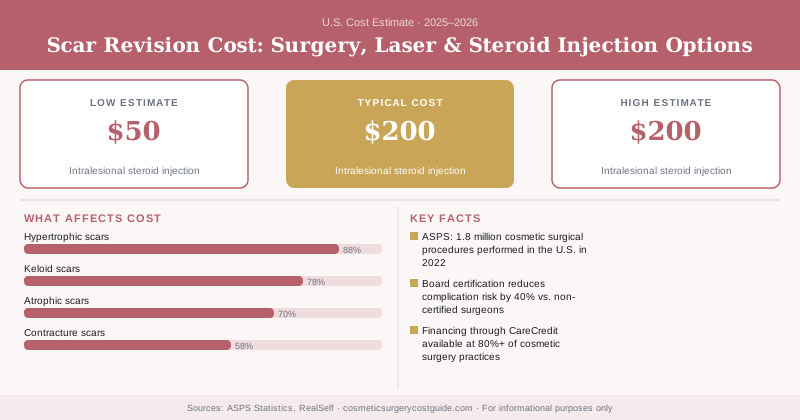
Scar Revision Cost by Approach
| Treatment Type | Cost Range |
|---|---|
| Steroid injections (per injection, keloids) | $150–$500 |
| Silicone sheets / gel (non-surgical) | $30–$80 |
| Laser resurfacing (per session; 1–3 sessions typical) | $1,000–$3,500 |
| Surgical excision and re-closure | $1,500–$5,000 |
| Z-plasty or W-plasty (geometric revision) | $2,000–$6,000 |
Understanding Your Scar Type — and Why It Matters
Not all scars respond to the same treatments. The right approach depends entirely on what kind of scar you have.
Hypertrophic scars are raised, red, and firm — but they stay within the original wound boundary. They respond well to steroid injections and silicone therapy, sometimes well enough to avoid surgery entirely. A series of 3–5 steroid injections at $150–$500 each can significantly flatten a hypertrophic scar. Laser resurfacing at 6–12 months post-injury further refines texture and color.
Keloid scars grow beyond the wound boundary, expanding into surrounding normal skin. They’re more common in patients with darker skin tones, and ASPS data confirms they affect a disproportionate number of patients with Fitzpatrick skin types IV–VI — an important consideration for both treatment choice and recurrence risk. According to the American Society of Plastic Surgeons, more than 100 million patients develop scars from surgery each year, with keloids representing some of the most challenging cases. Treatment typically combines surgical excision with immediate post-surgical radiation or steroid injection series to suppress regrowth. Surgery alone has a very high keloid recurrence rate; combination approaches are standard of care.
Atrophic (depressed) scars sit below the surrounding skin — common with acne scarring, chickenpox, or some surgical closures under tension. Surgical subcision, fat grafting, or filler can raise them; laser resurfacing smooths the texture.
Wide or misaligned scars from poor wound closure, infection, or high-tension locations (across joints, on the chest) often benefit most from surgical revision — particularly geometric techniques that redistribute tension along more favorable lines.
Both are surgical techniques that break up a straight-line scar into a geometric pattern, which accomplishes two things:
- Redirects tension — straight scars that cross joint creases or natural skin lines are constantly pulled, which widens them. Z-plasty rotates the scar direction to align with relaxed skin tension lines, reducing ongoing tension.
- Interrupts the scar visually — the eye tracks straight lines easily; a zigzag or broken pattern is far less noticeable at a glance.
Z-plasty is particularly effective for scars crossing the nose-cheek junction, jaw, neck, or joint creases. W-plasty achieves similar visual interruption with a different geometric approach. Both add surgical complexity and cost, but for the right scar, the outcome improvement is substantial.
What the Data Shows
The ASPS reports that more than 100 million patients develop scars from surgery annually worldwide — and that figure doesn’t include scars from trauma, burns, or skin conditions. The scale of need is enormous. For keloids specifically, research published in the Journal of the American Academy of Dermatology confirms that darker-skinned patients face a keloid risk 3–15 times higher than lighter-skinned patients — a disparity that meaningfully shapes treatment planning and realistic expectations for a large segment of patients seeking scar revision.
These numbers matter because they underscore that scar revision isn’t a niche or vanity procedure. For many patients, it’s a meaningful quality-of-life intervention — one that plastic surgeons perform routinely with well-established techniques.
When Insurance Applies
Purely cosmetic scar revision — improving how a scar looks without any functional issue — is self-pay in nearly every case. But functional indications do create coverage opportunities worth pursuing:
- Scars that restrict range of motion (crossing a joint with contracture) are frequently covered
- Burn scars causing tightness or functional limitation typically qualify under most major insurers
- Post-mastectomy reconstruction scars that require revision may be covered under federal mastectomy law requirements
- Scars near the eye or mouth that impair function (eyelid closure, lip movement) may qualify
Your surgeon can assess whether a functional indication exists and help document it. If there’s any legitimate functional component, it’s worth the pre-authorization attempt before assuming self-pay.
Factors That Move the Price
Scar size and location: A 1-inch facial scar costs far less to revise than a 12-inch abdominal scar. Facial work commands a premium because the technical demands are higher and the stakes are more visible. The face also heals better than the chest or shoulders — notorious for poor scar healing due to skin tension.
Technique required: Simple excision and re-closure sits at the low end of the surgical range. Z-plasty or W-plasty add operating time and complexity, pushing costs toward the upper end. Combining surgical revision with laser resurfacing at a later session adds another treatment cycle — but often produces the best final result.
Number of sessions: Laser resurfacing rarely achieves optimal results in one session. Most patients need 2–3 sessions spaced 6–8 weeks apart, which means budgeting $2,000–$10,500 for a full laser course depending on the device used and the extent of the scar.
Surgeon type: Plastic surgeons specializing in reconstructive work typically charge more than general dermatologists offering laser treatment. For surgical revision, a board-certified plastic surgeon is the appropriate choice. For laser-only management of smaller scars, a board-certified dermatologist with laser expertise is equally well-qualified and often more affordable.
Timing matters significantly for scar revision outcomes. Operating on a scar before it fully matures — typically 12–18 months post-injury — often produces inferior results because the tissue is still actively remodeling. Most plastic surgeons won’t perform elective scar revision on a fresh scar. If you’re being pushed toward early revision, ask why the surgeon believes early intervention is appropriate for your specific case. Patience in scar management consistently outperforms rushing.
Setting Realistic Expectations Before You Book
The most important conversation to have with your surgeon isn’t about technique or price — it’s about what “success” looks like for your specific scar. Ask to see before-and-after photos from patients with similar skin tones, similar scar types, and similar anatomic locations. Results vary significantly by these factors.
A 70% improvement in scar appearance is genuinely excellent in many cases. Getting to that realistic benchmark — rather than chasing invisibility — is what leads to patient satisfaction after revision. Surgeons who frame outcomes honestly before surgery tend to have patients who are far more satisfied with their results. That’s not pessimism. It’s good medicine.
Frequently Asked Questions
No — and any surgeon who tells you otherwise is overpromising. The goal of scar revision is significant improvement, not elimination. A well-executed scar revision can dramatically reduce a scar's width, raise a depressed scar, flatten a raised one, re-orient a scar that crosses tension lines, and improve color and texture. At 12–18 months post-revision, many patients find their scars blend well enough that concealer or clothing handles the rest. But the tissue was injured. There will always be some sign of that — the question is how minimal that sign can be.
Sometimes. Insurance covers scar revision when the scar causes functional limitation — restricting joint movement, causing chronic pain, or impairing vision if near the eye. Burn scars that limit function are frequently covered. Scars from prior surgeries that created tightness limiting range of motion may qualify. Cosmetic-only revision — improving the appearance of a scar that causes no functional problem — is self-pay in virtually all cases. Your surgeon can help you document functional limitation if it exists; that documentation is the key to coverage.
Surgical revision physically cuts out and re-closes the scar tissue, repositions the scar line, or uses geometric techniques like Z-plasty to redirect tension. It's appropriate for scars that are wide, depressed, raised, or poorly oriented. Laser resurfacing works on the surface — fractionated lasers resurface the texture, even pigmentation, and stimulate collagen remodeling. Laser is better for flat scars with texture or color issues; surgery is better for scars with structural problems. Many patients benefit from combining both: surgical revision first, then laser at 6–12 months to optimize the final appearance.