You’ve had one consultation. The surgeon quoted $11,500 for a rhinoplasty and recommended an open approach with rib cartilage grafting. You’re not sure if that’s right, not sure if that’s expensive, and not sure whether you should ask more questions or just book the surgery.
Getting a second opinion is the correct instinct. Here’s why it matters more in cosmetic surgery than most patients realize, and what to actually do with the second consultation.
Why Second Opinions Matter More in Cosmetic Surgery
In most medical specialties, second opinions help verify a diagnosis. In cosmetic surgery, they do something more: they expose the enormous variation in surgical approach, technique preference, and price that exists for identical-looking situations.
Price variation: Same procedure, same outcome goal, same geographic market — quotes can vary $2,000–$8,000 for a rhinoplasty, $4,000–$12,000 for a facelift. Not because one surgeon is better or worse, but because fee structures, overhead, and practice positioning differ.
Approach variation: One surgeon recommends open rhinoplasty with rib graft; a second says closed rhinoplasty with septal cartilage is sufficient for your goals. One recommends a full facelift at 48; another says a SMAS plication will achieve your goals for 40% less. These are real clinical differences with cost and recovery implications.
Recommendation verification: When you don’t know what you actually need, having two qualified surgeons independently arrive at the same recommendation is meaningful confirmation.
| What Second Opinions Reveal | Frequency | Potential Impact |
|---|---|---|
| Significant price variation for same procedure | Very common | $2,000–$8,000 savings possible |
| Different recommended technique | Common | Different recovery, cost, scarring |
| One surgeon recommends more work | Moderate | Over-treatment is real |
| Different procedure recommended entirely | Occasional | Major cost/outcome difference |
| Both agree on approach | Common | Confirms your direction |
When Second Opinions Are Most Valuable
Any surgical procedure over $6,000: The financial stakes justify the time and any consultation fee.
When the recommended approach seems aggressive or extensive: If a surgeon recommends a full facelift for mild concerns, or open rhinoplasty for a simple hump reduction, get a second read on whether that scope is appropriate.
When you feel pressure: Any time a surgeon or coordinator implies you should book this week for a special offer, that’s exactly when you should slow down and get another opinion. Reputable surgeons don’t pressure patients into rushed decisions.
When something feels off: Trust this instinct. A consultation where you felt talked at rather than listened to — where the surgeon seemed disinterested in your specific goals — is a signal to consult elsewhere.
Complex revisions or unusual cases: For revision rhinoplasty, correction of a prior procedure, or anything with significant complexity, always get a second specialist opinion.
What to Ask at Your Second Consultation
Don’t reveal what the first surgeon recommended. Let the second surgeon assess you independently, then share the first opinion and ask directly:
“I’ve had a consultation where open rhinoplasty with rib graft was recommended. Do you agree that approach is necessary for my goals?” — This shows you whether there’s genuine agreement or a real divergence.
“What is your recommended approach and why?” — You’re listening for reasoning, not just a conclusion. A surgeon who explains their thinking is a surgeon you can evaluate.
“What is your experience with this specific procedure, and roughly how many have you performed?” — Rough volume gives you context.
“What result can I realistically expect, and what would I need to accept?” — How honest they are about limitations tells you a lot about their character.
“What is your revision rate for this procedure?” — Most surgeons won’t quote a precise number, but the question reveals whether they’ve thought about it and whether they’re willing to be transparent.
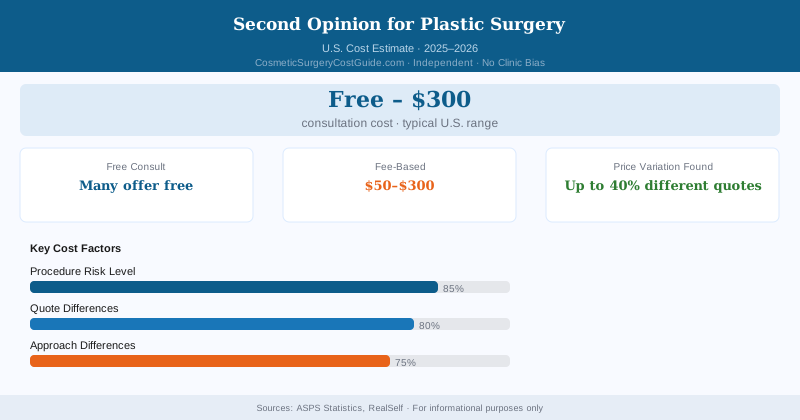
Many plastic surgery consultations carry fees of $100–$350. For a second opinion, this is worthwhile — but you can sometimes manage the cost:
- Ask upfront whether the consultation fee is applied to surgery if you book — most practices do this
- Some surgeons waive consultation fees for specific procedures or patient situations — ask
- Virtual consultations are often available for a second opinion and typically cost $50–$150 less than in-person
- If you ultimately don’t proceed with either surgeon, you’ve spent $200–$700 on information that clarifies a $10,000+ decision — that’s a reasonable price for important information
Reading the Two Consultations Against Each Other
After two consultations, you’ll have one of several situations:
Both agree on approach and scope: Strong signal that the recommendation is appropriate. Now you’re choosing between two qualified surgeons based on rapport, results portfolio, and price.
One recommends a more extensive procedure: The more extensive recommendation isn’t automatically wrong — but ask yourself whether the reasoning was compelling or whether it felt like upsell. Get a third opinion if the stakes are high.
Approaches differ but both are reasonable: This happens often — different surgeons genuinely prefer different techniques. Research the techniques, ask follow-up questions about trade-offs, and choose the surgeon whose reasoning you find more compelling.
Significant price difference for equivalent approach: The lower price isn’t automatically lower quality. Verify credentials of both surgeons equally; if they’re equivalent, the lower price from a similarly qualified surgeon in the same market is a real savings.
What Second Opinions Don’t Do
A second opinion doesn’t tell you who’s right with certainty. Both surgeons might be wrong. Both might be right but with different trade-offs. A second opinion gives you more information and independent perspectives — it doesn’t eliminate the need for your own judgment.
More consultations don’t always mean better information either. Three consultations with three divergent recommendations can produce paralysis rather than clarity. Two consultations are almost always sufficient; three are occasionally useful for genuinely complex situations.
Be cautious of the surgeon who disparages the approach or reputation of your first consultation. Established surgical ethics discourages attacking colleagues in front of patients. A surgeon who speaks poorly of another surgeon’s recommendation without examining you independently is demonstrating poor professional judgment — which may correlate with poor clinical judgment as well. The best response to a divergent opinion is “I would approach this differently, and here’s why,” not “the other surgeon has no idea what they’re doing.”
Bottom Line
Get a second opinion for any surgical cosmetic procedure over $6,000, any situation where the recommendation felt unclear or pressured, and any complex case where you have doubts. The consultation fee is modest relative to the procedure cost, and the information value — both price comparison and approach verification — is significant. Let the second surgeon assess you independently before you reveal the first recommendation. Compare the reasoning, not just the conclusions.