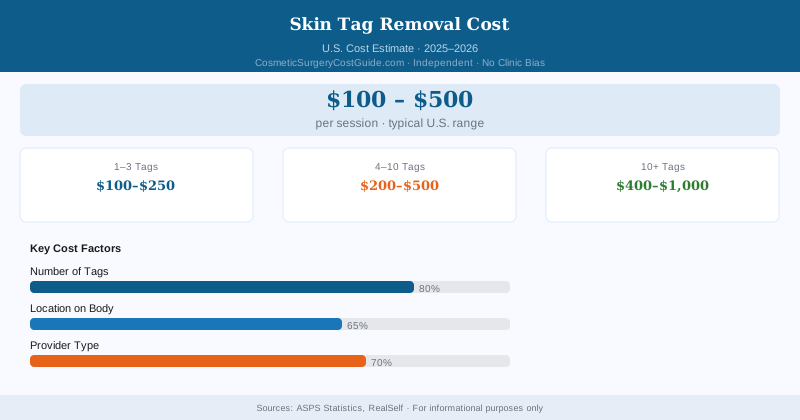
Skin tags are harmless — but that doesn’t mean you have to keep them. What’s the fastest, cheapest, and safest way to remove them?
The answer depends on where the tags are, how many you have, and what you’re comfortable doing yourself. A single small neck tag can be handled with a $15 at-home cryotherapy kit in five minutes. Three tags on your eyelid require an ophthalmologist appointment. The method matters as much as the price — and choosing the wrong approach for the wrong location is how a $30 problem becomes a $1,500 problem.
What is a skin tag?
Skin tags (acrochordons) are soft, flesh-colored growths that hang from the skin surface on a thin stalk. They’re completely benign — no cancer risk, no spread, no medical consequence. They form in areas where skin rubs against skin or clothing: neck, armpits, groin, under breasts, eyelids.
They’re also extremely common. The American Academy of Dermatology estimates that nearly half of all adults develop at least one skin tag during their lifetime. ASPS data confirms that skin lesion removal — a category that includes skin tags — is among the most frequently performed office procedures annually, with tens of millions of Americans affected. Insurance doesn’t cover removal; skin tags are classified cosmetic regardless of how uncomfortable they are.
Office removal cost: what you’ll actually pay
| Removal Method | Cost (1–3 Tags) | Per Additional Tag | Appropriate Locations | Recovery |
|---|---|---|---|---|
| Snip excision | $100–$150 | $20–$40/tag | Body, face (not eyelid) | 7–10 days (scab) |
| Cryotherapy (liquid nitrogen) | $150–$250 | $25–$50/tag | Body, face (not eyelid) | 7–14 days |
| Electrocautery | $150–$300 | $25–$50/tag | Body, face (not eyelid) | 5–10 days |
| Eyelid removal (specialist) | $200–$500 | Varies | Eyelid only | 5–7 days |
| Bundle (10+ tags, single visit) | $300–$600 flat | Included | Body | Varies |
At-home options: what works and what doesn’t
| At-Home Method | Cost | Works For | Never Use On |
|---|---|---|---|
| Cryotherapy kit (Compound W Freeze Off) | $10–$30 | Small tags, neck and body | Face, groin, eyelids |
| Tag band / string ligation | $10–$20 | Small body tags | Face, neck (nerve proximity), eyelids |
| Salicylic acid | $5–$15 | Not well-suited for skin tags | Not recommended |
Office procedures: how each one works
Snip excision is the fastest method in a dermatologist’s office. A topical or injected anesthetic numbs the area, and the tag is cut at its base with small sterile scissors — done in 2–3 minutes per tag. A small scab forms and falls off in 7–10 days. Many dermatologists prefer this method because it’s precise and the removed tissue can be sent for biopsy if there’s any uncertainty about what the growth actually is.
Cryotherapy applies liquid nitrogen directly to the tag. The extreme cold destroys the tissue, which darkens, scabs, and falls off over 1–2 weeks. It works well for small-to-medium tags and may need two applications for larger ones. Slightly more discomfort than snip excision, but no bleeding.
Electrocautery uses an electric current to burn through the stalk and seal the base simultaneously. Good for tags that might bleed with snip excision. The procedure produces a faint burnt smell that’s completely normal.
At-home methods: when they’re reasonable
Consumer cryotherapy kits like Compound W Freeze Off use dimethyl ether propane — cold enough to destroy small skin tags. They genuinely work for small tags (under 5mm) on the neck, trunk, and arms. Follow instructions precisely: the applicator must contact the tag, not surrounding skin. Results take 7–14 days and sometimes require a second application.
String ligation cuts off blood supply to the tag’s stalk. You tie a thin thread or specialized elastomeric band around the base; the tag darkens, shrivels, and falls off over 7–10 days. It works, but it’s slower than cryotherapy and carries a minor infection risk if not placed cleanly.
Neither method is appropriate for tags on the face, in sensitive skin fold areas, or on the eyelids.
Most skin tags are unmistakable: soft, flesh-colored, hanging on a stalk, smooth surface, no spontaneous bleeding or color variation. But not every small skin growth is a benign tag — and some genuinely concerning growths get misidentified and treated at home with disastrous delay.
See a dermatologist before treating anything that:
- Is dark brown, black, or has multiple colors in one lesion
- Has an irregular or jagged border
- Is flat rather than raised on a visible stalk
- Has recently changed in size, color, or texture
- Bleeds without any injury or trauma
- Is crusted, ulcerated, or not healing normally
Dermatofibromas, sebaceous cysts, warts, molluscum contagiosum, and — rarely — early melanoma can all be mistaken for benign skin tags. A dermatologist’s in-office assessment takes 60 seconds and removes all doubt. If there’s any question about what you’re looking at, don’t treat it at home. The cost of identifying something serious after a six-month at-home treatment delay is far higher than an office visit.
Eyelid skin tags: a different category entirely
Skin tags on or immediately adjacent to the eyelid should not be treated at home under any circumstances. The eyelid margin contains delicate structures — the meibomian glands, the lid margin architecture, the lacrimal drainage system — that can be permanently damaged by thermal, cryogenic, or chemical injury from at-home products.
Eyelid skin tags require removal by an ophthalmologist or oculoplastic surgeon in a proper clinical setting. Cost is $200–$500 depending on the provider and the number of tags — but there’s simply no safe at-home alternative for this location.
Does insurance cover skin tag removal?
Almost never. Skin tags are classified cosmetic across virtually all insurance plans because they cause no medical harm. The only documented exceptions involve tags causing functional problems — a large eyelid tag causing visual obstruction, for example — with thorough clinical documentation. Even with good documentation, coverage is frequently denied.
Budget to pay out of pocket. Ask your dermatologist about bundle pricing if you have multiple tags — removing 8–10 tags in a single visit is almost always cheaper per tag than returning for multiple appointments.
Never attempt to remove a growth on or near the eyelid at home. Consumer cryotherapy kits, scissors, or string ligation near the eyelid risk freezing the lid margin, cutting into lid structures, or causing cold injury to the cornea. An injury to the eyelid can cause permanent cosmetic and functional damage — lid malposition, scarring, or corneal injury — that is far more expensive and difficult to correct than a $300 specialist visit. Only an ophthalmologist or oculoplastic surgeon should treat eyelid skin tags. This is non-negotiable.
Bottom line
Single small skin tag on your neck or arm? A $15 at-home cryotherapy kit is reasonable and effective for small tags. Three or more tags at the dermatologist? Budget $150–$300, plan 15 minutes in the office, and ask about bundle pricing for multiple removals at once. Eyelid tags or any growth you’re not 100% certain is a skin tag? Book a dermatologist appointment before doing anything. The stakes on getting that wrong are too high to skip the professional evaluation.
Frequently Asked Questions
In a dermatologist's office, local anesthetic is applied before snip excision or electrocautery — the procedure itself is painless. You'll feel the numbing injection briefly. At-home cryotherapy kits cause a brief intense cold sensation and mild burning that lasts a few minutes. Recovery from office procedures is minimal: a small scab forms and falls off in 7–10 days.
Removed skin tags don't grow back at the exact removal site. However, new skin tags can develop in the same general area if you're prone to them. People who develop skin tags tend to keep developing them over time — one removal doesn't prevent future tags from forming. Multiple removals over the years are common for tag-prone individuals.
Skin tags form in areas of skin friction and are associated with obesity, diabetes, and metabolic syndrome. They're also more common during pregnancy due to hormonal changes. There's no proven way to prevent them entirely, but weight loss and blood sugar management can slow their development in metabolically linked cases.