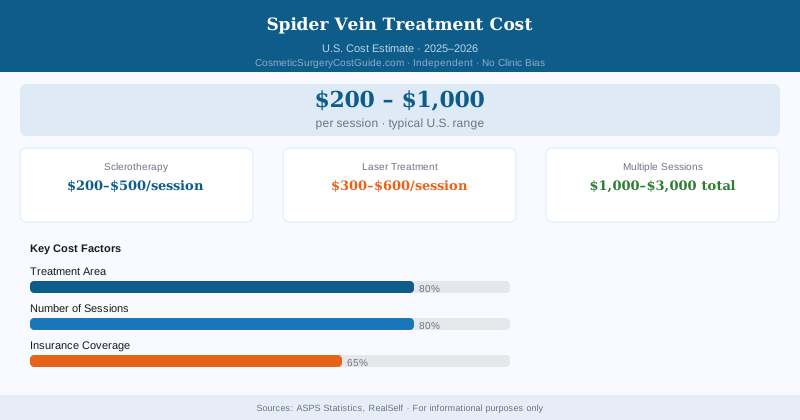
Let’s clear up something that confuses a lot of patients before spending any money: laser is not always better than injection for spider veins. That’s a common assumption — newer technology must work better, right? Not here. For leg spider veins, sclerotherapy (injection) has been the gold standard for decades and consistently outperforms laser. Laser has its place, but it’s not the universal upgrade many patients expect.
Spider veins — the small, web-like clusters of red, blue, or purple blood vessels visible through the skin — affect over 50% of American women and about 45% of men according to published estimates. They’re most common on the legs and face. Insurance classifies them as cosmetic for nearly all patients, so you’ll be paying out of pocket.
Here’s a realistic look at costs and which method actually works for your situation.
Spider Vein Treatment Cost
| Treatment | Cost Per Session | Sessions Needed | Total Cost |
|---|---|---|---|
| Sclerotherapy (legs) | $300–$500 | 2–4 | $600–$2,000 |
| Laser vein treatment (legs) | $300–$600 | 2–4 | $600–$2,400 |
| IPL for facial veins | $300–$700 | 2–3 | $600–$2,100 |
| Laser for facial spider veins | $300–$600 | 2–4 | $600–$2,400 |
| VeinGogh (facial/fine veins) | $200–$400 | 2–3 | $400–$1,200 |
| RF ablation (larger reticular veins) | $500–$1,500 | 1–2 | $500–$3,000 |
Sclerotherapy vs. Laser: The Right Tool for Each Situation
Sclerotherapy: A chemical solution (sclerosant — typically polidocanol or sodium tetradecyl sulfate) gets injected directly into the spider veins using a very fine needle. The irritant causes the vein walls to swell, stick together, and scar closed. The body reabsorbs the closed vein over 4–8 weeks.
Best for: Leg spider veins larger than about 1mm. This is the gold standard for leg vein treatment. It’s more effective than laser for deeper or larger spider veins and the reticular “feeder” veins that supply them.
Laser vein treatment: Laser energy passes through the skin and targets hemoglobin in the blood vessel. The heat closes the vessel without any injection at all.
Best for: Facial spider veins (injections in the face are generally avoided), very fine spider veins too small for a needle, and patients who strongly prefer to skip injections.
If you have leg spider veins and someone immediately recommends laser before even mentioning sclerotherapy, that’s worth a second opinion.
- Sessions last 30–60 minutes
- Multiple injections per session (often 20–50 injection points)
- Compression stockings worn for 24–48 hours post-treatment (important for outcome)
- Exercise restriction for 24 hours
- Veins look worse (darker) for 1–4 weeks before they fade and disappear
- Full result visible at 6–8 weeks
Most patients need 2–4 sessions spaced 4–8 weeks apart. Each session typically treats a different area or adds additional injection points to areas treated previously.
Facial Spider Veins: Different Approach
Facial spider veins — common around the nose, cheeks, and chin, often from rosacea or sun damage — need a different game plan than leg veins:
IPL photofacial: Broad-spectrum light targets hemoglobin. Works well for diffuse facial redness and fine surface vessels. Cost: $300–$700/session, 2–3 sessions typical.
Pulsed Dye Laser (Vbeam): Specifically targets vascular lesions at 585–595nm wavelength. Very effective for facial spider veins, port wine stains, and cherry angiomas. Cost: $300–$600/session.
VeinGogh: An ohmic thermolysis device that uses a tiny probe to deliver heat precisely to individual superficial vessels. Excellent for very fine facial spider veins that other devices miss. Cost: $200–$400/session.
Sclerotherapy is generally avoided on the face because of injection risks near facial vasculature.
Insurance Coverage
Spider vein treatment is almost universally classified as cosmetic. Don’t expect coverage.
Varicose veins are a different story. The larger, bulging varicose veins — not spider veins — can qualify for insurance coverage when they cause symptoms: leg heaviness, pain, swelling, skin changes. Varicose vein treatment (EVLT, radiofrequency ablation) is a separate, larger intervention costing $1,500–$4,000+ per leg, but may be covered with proper documentation.
If you have both spider veins and symptomatic varicose veins, address the varicose veins first. Treating the underlying pressure source may improve some spider veins on its own, and the symptomatic varicose vein treatment may be covered.
Spider veins frequently recur — not because treated veins reopen (successfully closed veins don’t), but because the underlying causes (chronic venous pressure, genetics, prolonged standing) continue creating new ones. Most patients need retreatment every 2–5 years as new veins develop. Compression stockings worn regularly, maintaining a healthy weight, and consistent walking reduce the rate of new spider vein formation.
Legs: Compression Stockings After Treatment
Post-sclerotherapy compression matters for results — this isn’t optional.
- Wear compression stockings immediately after treatment and for 24–48 hours continuously
- They collapse the treated veins while the sclerosant does its work
- They reduce bruising and promote faster clearing
Compression stockings (15–20 mmHg) run $25–$60 at most pharmacies. Most practices recommend you bring them to your appointment.
How to Find a Good Provider
Spider vein treatment is performed by dermatologists, phlebologists, and vascular specialists. For leg veins, choose a provider who can also assess you with ultrasound to rule out significant underlying varicose or saphenous insufficiency. Treating spider veins without addressing significant underlying venous pressure produces poor results — the feeding pressure keeps creating new veins faster than you can treat them.
Bottom Line
Leg spider vein treatment via sclerotherapy: $300–$500/session, 2–4 sessions total = $600–$2,000. Facial spider veins with IPL or pulsed dye laser: $300–$700/session, 2–3 sessions = $600–$2,100. Results are generally very good for properly selected patients, but plan for periodic retreatment as new veins develop over time.